Opinion
The storm clouds aren't on the east coast, Treasurer. They're over Perth
WA's Treasurer says economic gloom is an east coast thing. Perth's inflation, jobs, mines, malls and house prices tell a different story.
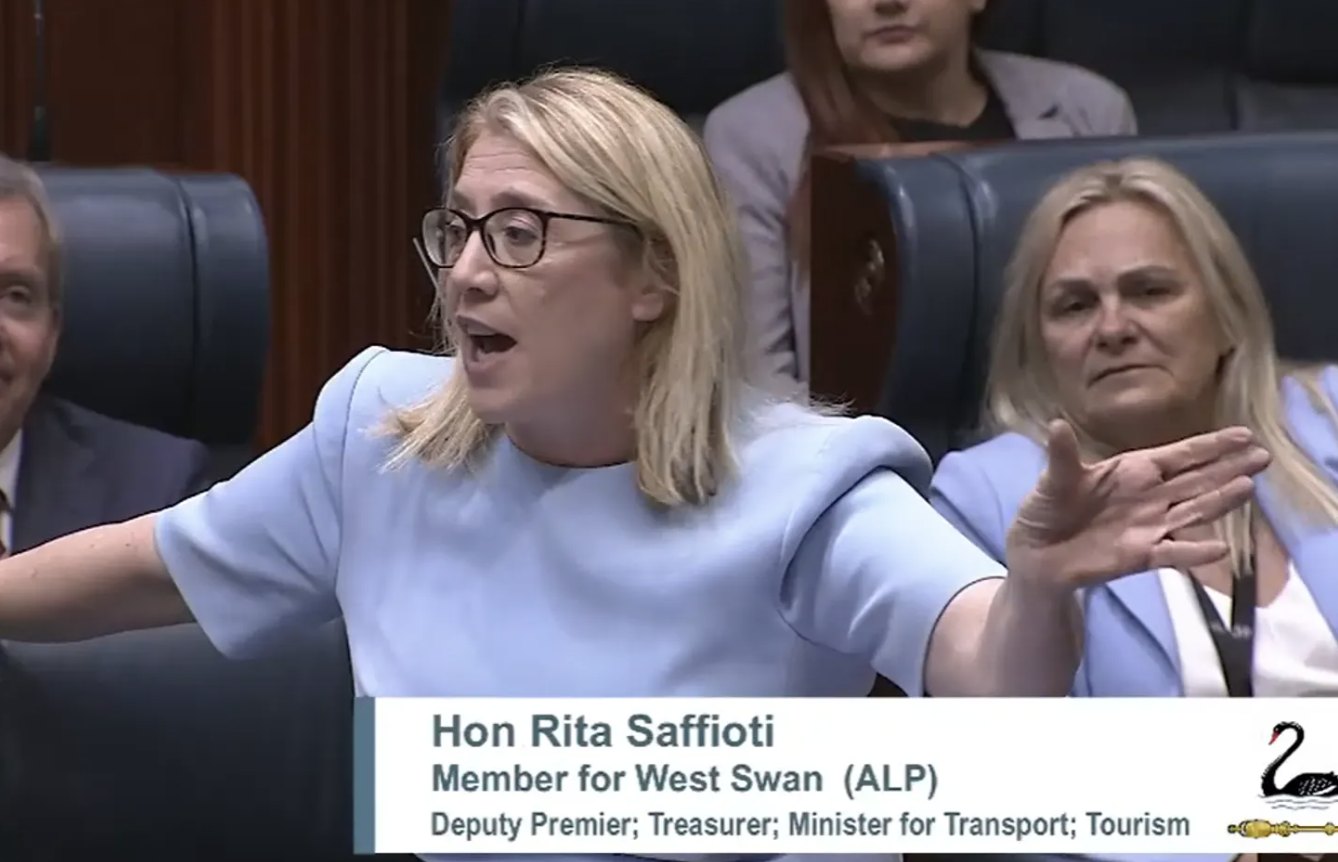
Rita Saffioti has a message for West Australians worried about the economy: relax, that's a Sydney and Melbourne problem.
In an interview with The Australian Financial Review this week, the Treasurer and Deputy Premier said the doom and negative commentary "belongs more to the east coast than it does to Western Australia". Her bigger worry, she said, was that gloom over east might dent confidence over here.
She went further: "Sometimes what you find in the economy is confidence not matching the facts, and in Western Australia, our fundamentals are still very, very strong."
Those are words that could come back to bite her. On 15 September 2008, the day Lehman Brothers collapsed, US presidential candidate John McCain told voters that "the fundamentals of our economy are strong". The global financial crisis was already under way, and the line dogged him for the rest of the campaign. Closer to home, targeting the east coast is a well-worn Labor trope. Mark McGowan made an art form of it during COVID, and the current Premier and his team still reach for it: in August, Roger Cook dismissed the authors of a Productivity Commission report critical of WA's GST deal as "East Coast clowns".
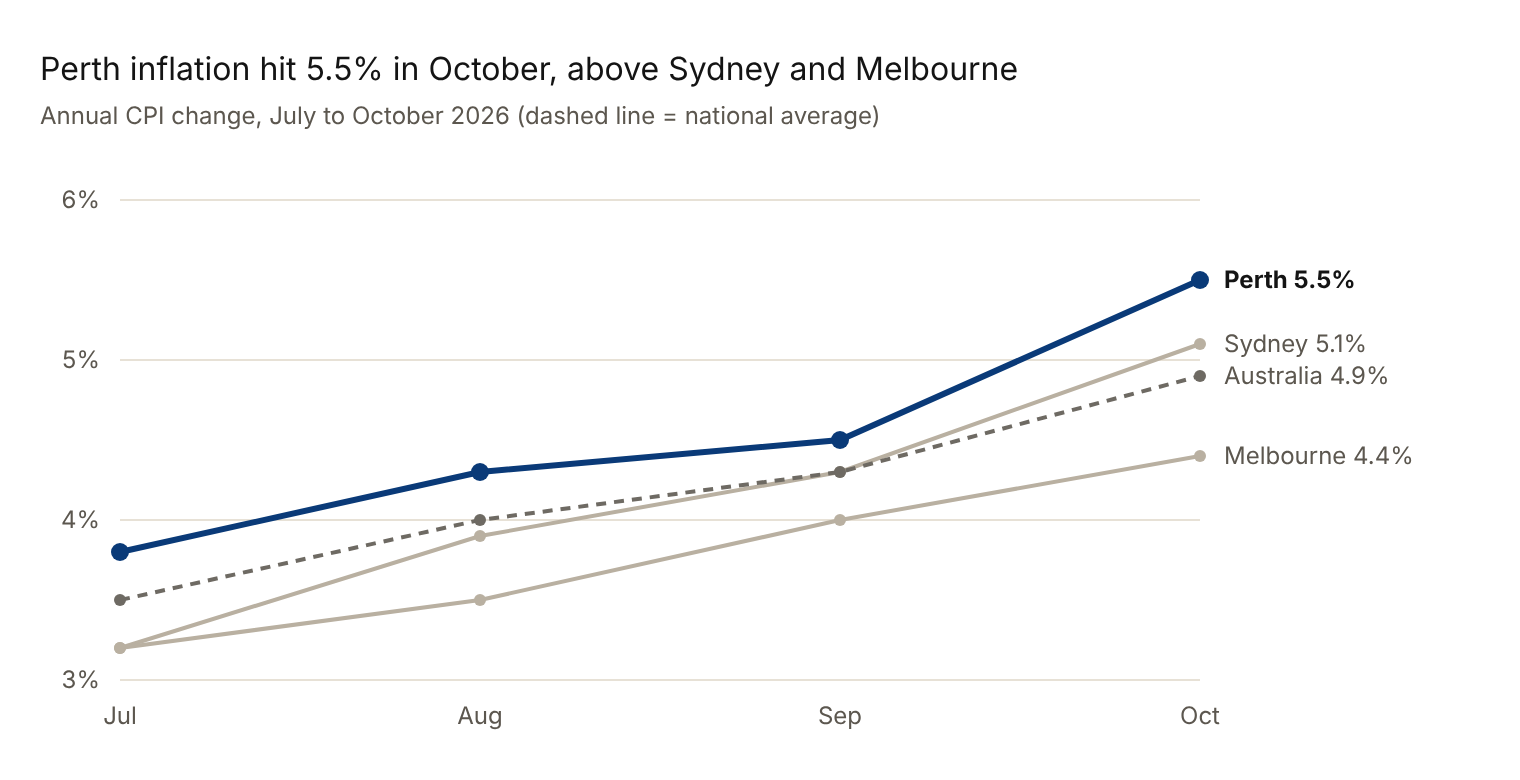
On the very same day, the Australian Bureau of Statistics reported that consumer prices in Perth had risen 5.5 per cent over the year to October. That is faster than Sydney. It is faster than Melbourne.
That is the trouble with blaming the weather on the other side of the Nullarbor. The clouds are already here.
Prices are rising faster here, not slower
Inflation at 5.5 per cent is not a number on a Treasury chart. It is rent, groceries, insurance, school fees and the power bill, and Perth households are paying more for all of it than their east coast counterparts.
Power bills are part of it. Electricity led the rise in October's national inflation figures, up 25.2 per cent over the year as Commonwealth bill rebates ran out. Perth households lost that relief too, after the state's own household electricity credits were not renewed for 2025-26. The Treasurer can hardly call higher power bills an east coast story.
The Treasurer argues her government has been fiscally conservative and that its spending per head has been tight. Yet general government expenses rose by close to 7 per cent in 2025-26, and the May budget carried cost-of-living handouts worth hundreds of millions of dollars that some economists warned would add fuel to the fire.
Western Australia banked close to $11 billion in mining royalties last financial year, propelling it to its eighth consecutive operating surplus in the May budget. You cannot bank an $11 billion royalty windfall, spend heavily, and then treat local inflation as somebody else's weather system.
The jobs picture has turned
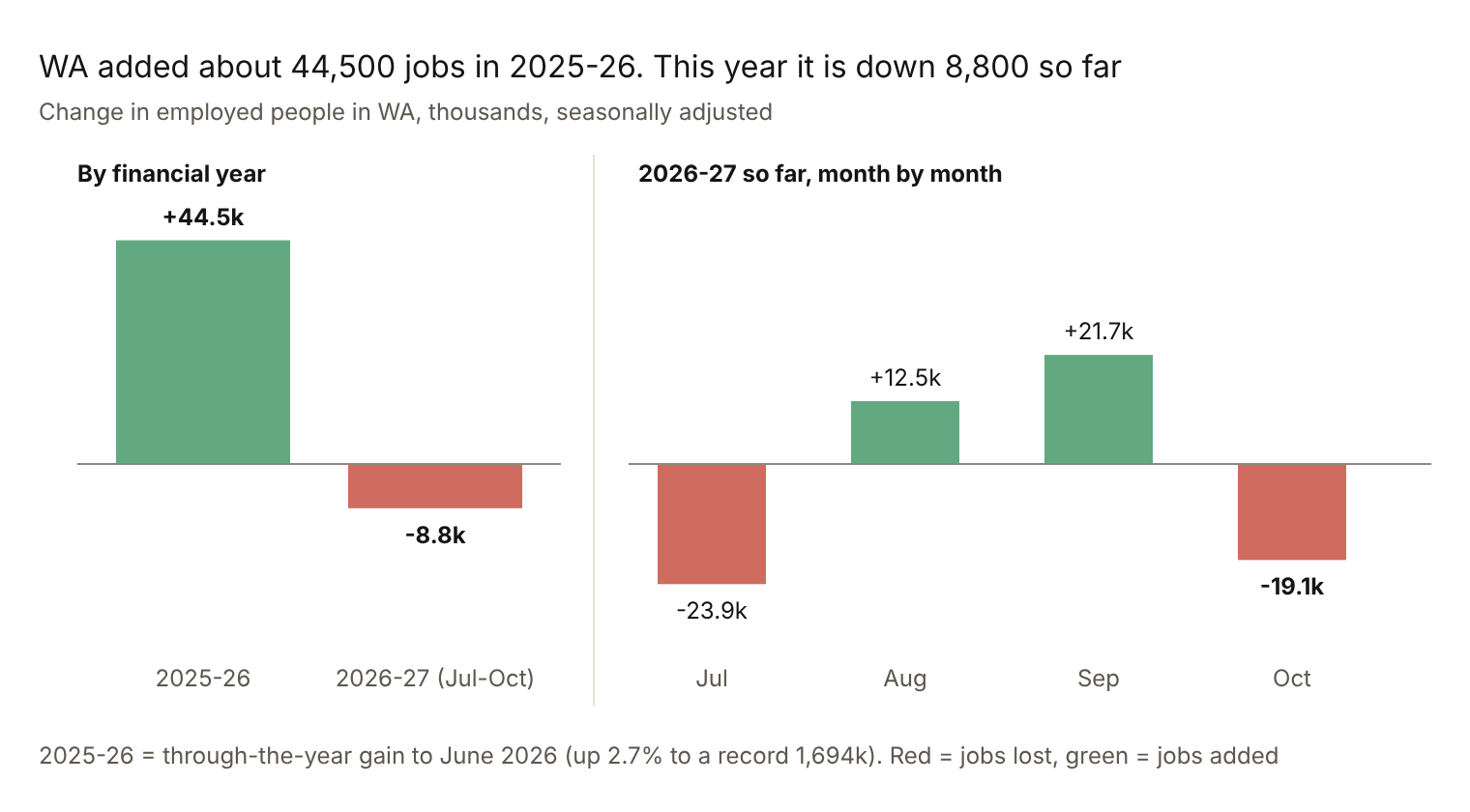
WA's unemployment rate rose from 4.2 per cent in September to 4.5 per cent in October. In the same month, WA recorded the sharpest fall in employment of any state, down 1.1 per cent. After adding about 44,500 jobs in 2025-26, WA has now lost about 8,800 jobs so far this financial year.
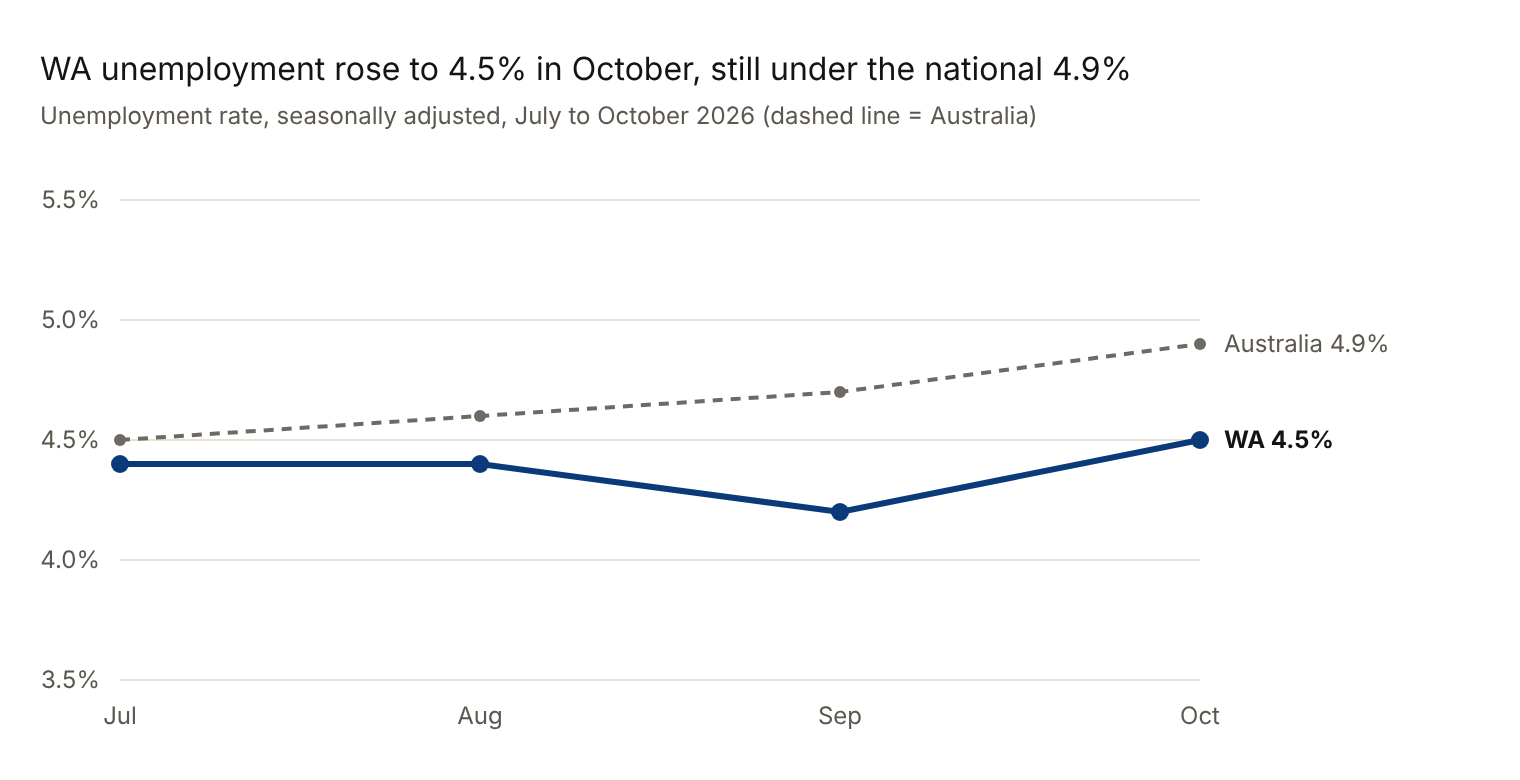
To be fair to the Treasurer, 4.5 per cent is still the lowest unemployment rate of any state, and that is worth saying. But in an economy, direction matters more than position. In October, WA's direction was the wrong one, and it moved faster than anyone else's.
The mines that pay the bills are shedding workers
The Treasurer concedes mining is the lion's share of WA's economy. That is exactly where the cracks are showing.
In October, BHP said it would cut about 300 roles across its Pilbara iron ore operations, pointing to iron ore prices down roughly 14 per cent since January and higher fuel and shipping costs. Hancock Iron Ore cut jobs at Roy Hill in June. Mineral Resources shut its Lucky Bay mineral sands mine near Kalbarri mid-year, with more than 100 jobs gone, blaming Middle East disruption and soaring diesel and shipping costs.
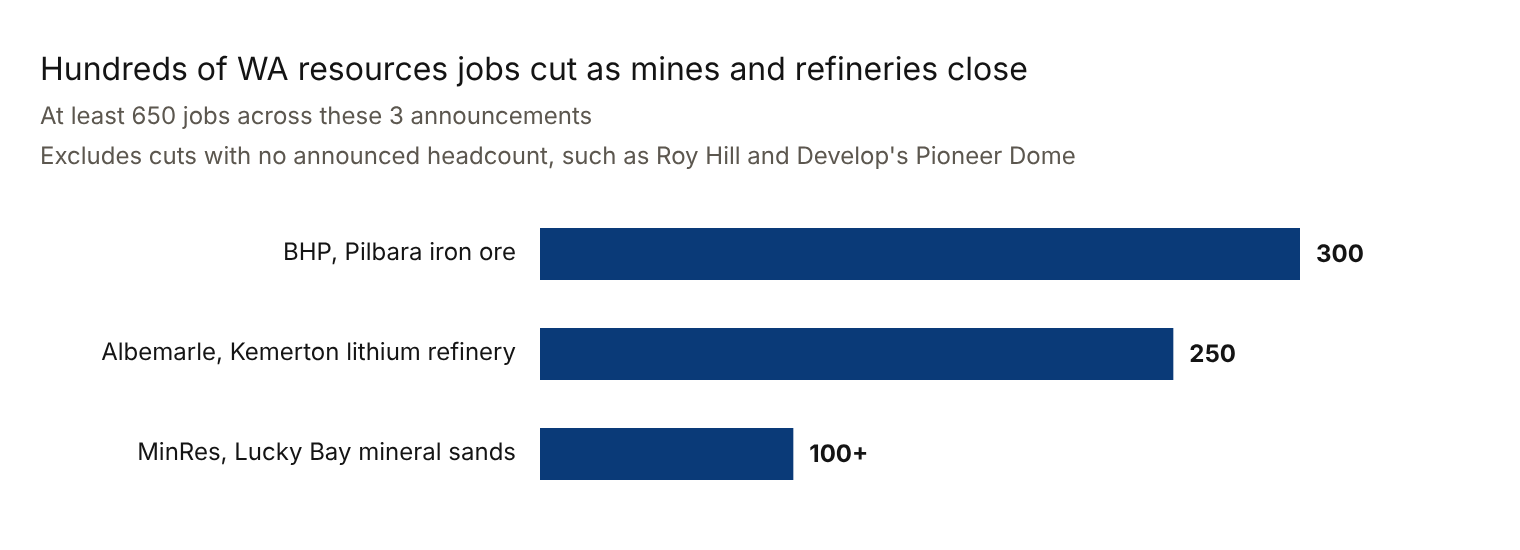
Lithium, once sold to us as WA's next great boom, has become a story of mothballing. This week Develop Global told the ASX it will pause its Pioneer Dome lithium mine in December and place it on care and maintenance, citing the recent substantial fall in the lithium price. Develop says the project would be marginal once the floor price in its offtake deal with Trafigura expires at the end of December. Only a small crew will stay on site.
It follows Albemarle switching off its last remaining refining train at Kemerton near Bunbury, with 250 local workers made redundant, after the company said Western producers simply cannot compete on cost. Mines are being paused and refineries mothballed, and WA is left waiting for a price recovery that may not come.
None of these are east coast stories. They are Pilbara, Goldfields, Bunbury and Kalbarri stories. And the royalties that underwrote eight straight budget surpluses come from these same commodities. When iron ore prices fall and costs rise, that is not doomsday talk. That is the foundation of the state budget shifting.
We have seen this film before
The Treasurer's confidence would be easier to share if WA had not been here before.
In December 2014, the Barnett government admitted that a fall of more than 40 per cent in the iron ore price since its budget would cost the state $7.1 billion in royalties, turning a forecast surplus into a deficit of almost $1.3 billion. A year later, Treasurer Mike Nahan was forecasting a $3.1 billion deficit and blaming a "perfect storm" of falling commodity prices. WA lost its AAA credit rating with Moody's in August 2014 and was downgraded again in February 2016, while net debt headed towards $30 billion and the government went looking for assets to sell. Voters threw it out in 2017.
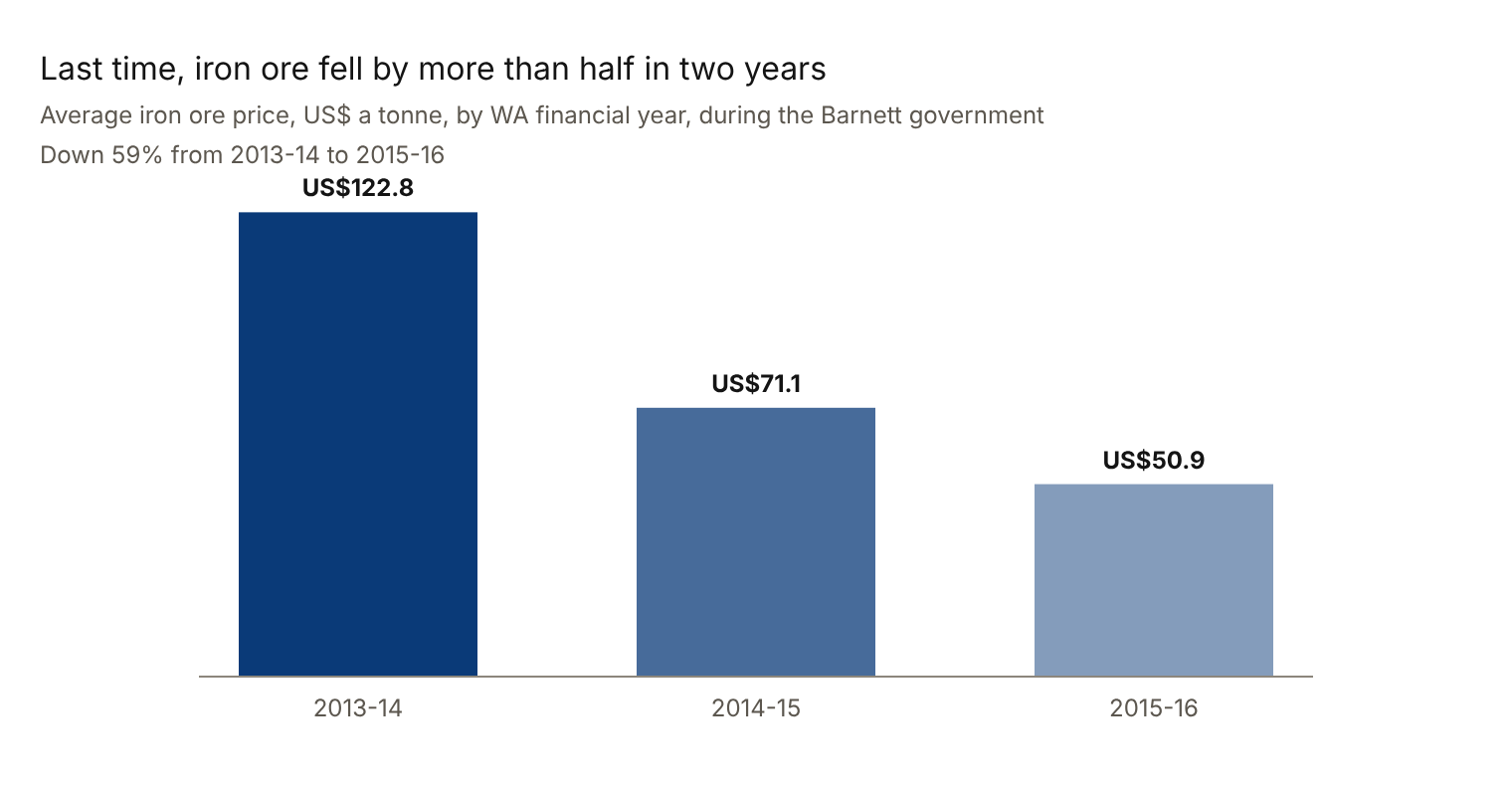
To be fair, Saffioti starts from a far stronger position: eight straight surpluses, low debt and a triple-A rating from both major agencies. But the lesson of 2014 is not that WA was broke. It is how quickly a budget built on iron ore can unravel. Back then royalties made up about a fifth of the state's income, and a budget that looked fine in May was in deficit by Christmas. The problem was never confidence. It was the price.
China is slowing, and the US dollar is rising
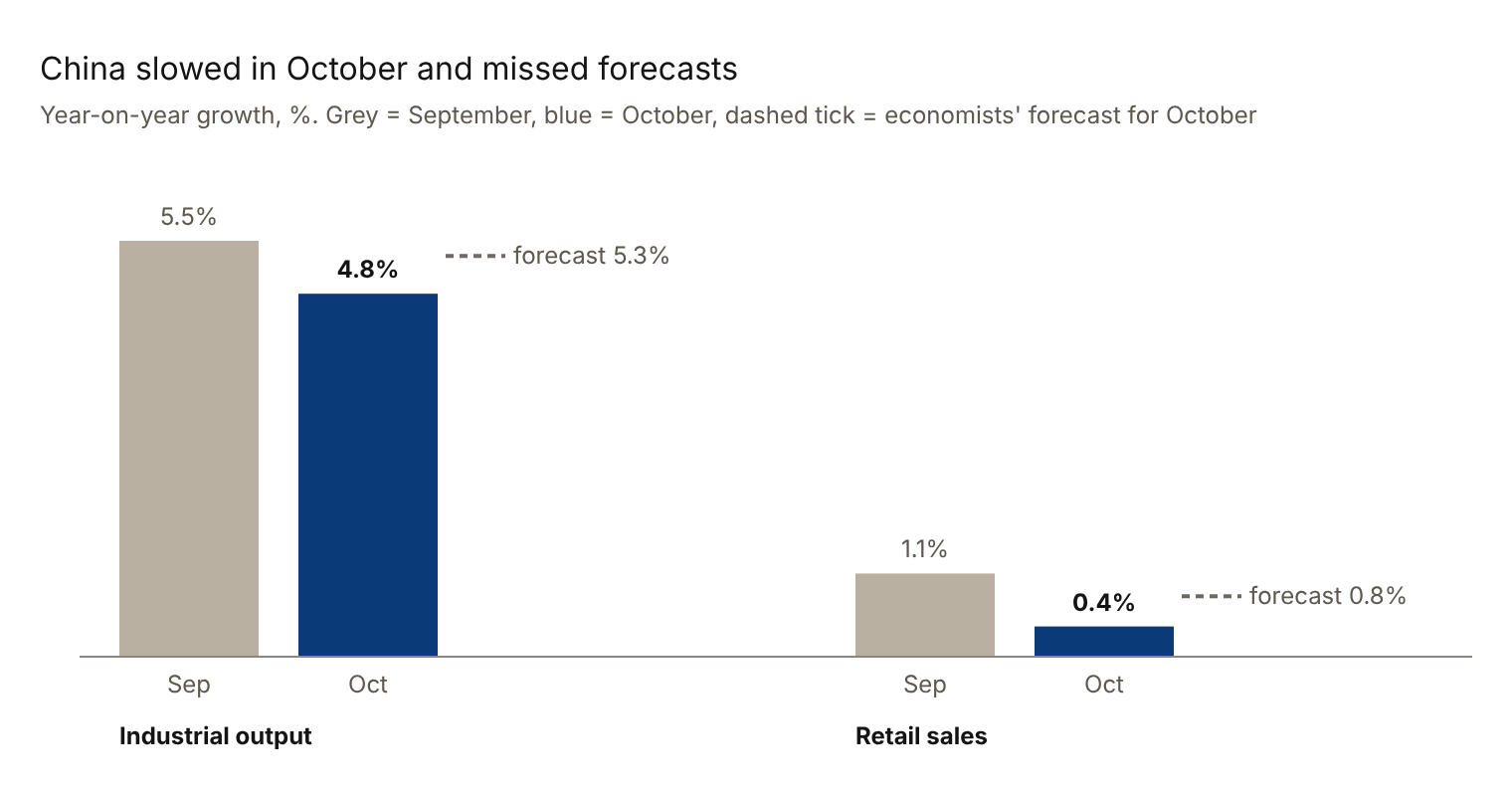
That price depends on China, and China is soft. Official figures released on 16 November showed Chinese industrial output grew 4.8 per cent in October, down from 5.5 per cent in September and below forecasts. Retail sales rose just 0.4 per cent. Fixed-asset investment fell 8.1 per cent over the first ten months of the year, with China's property downturn now in its fifth year. A China that builds less needs less steel, and less Pilbara iron ore. Iron ore prices are already down around 14 per cent since January.
Then there is the US dollar. The US Dollar Index climbed to around a 19-month high in mid-November as markets bet on further US rate rises. Commodities are priced in US dollars, so a stronger greenback makes them dearer for buyers such as China and tends to drag prices lower.
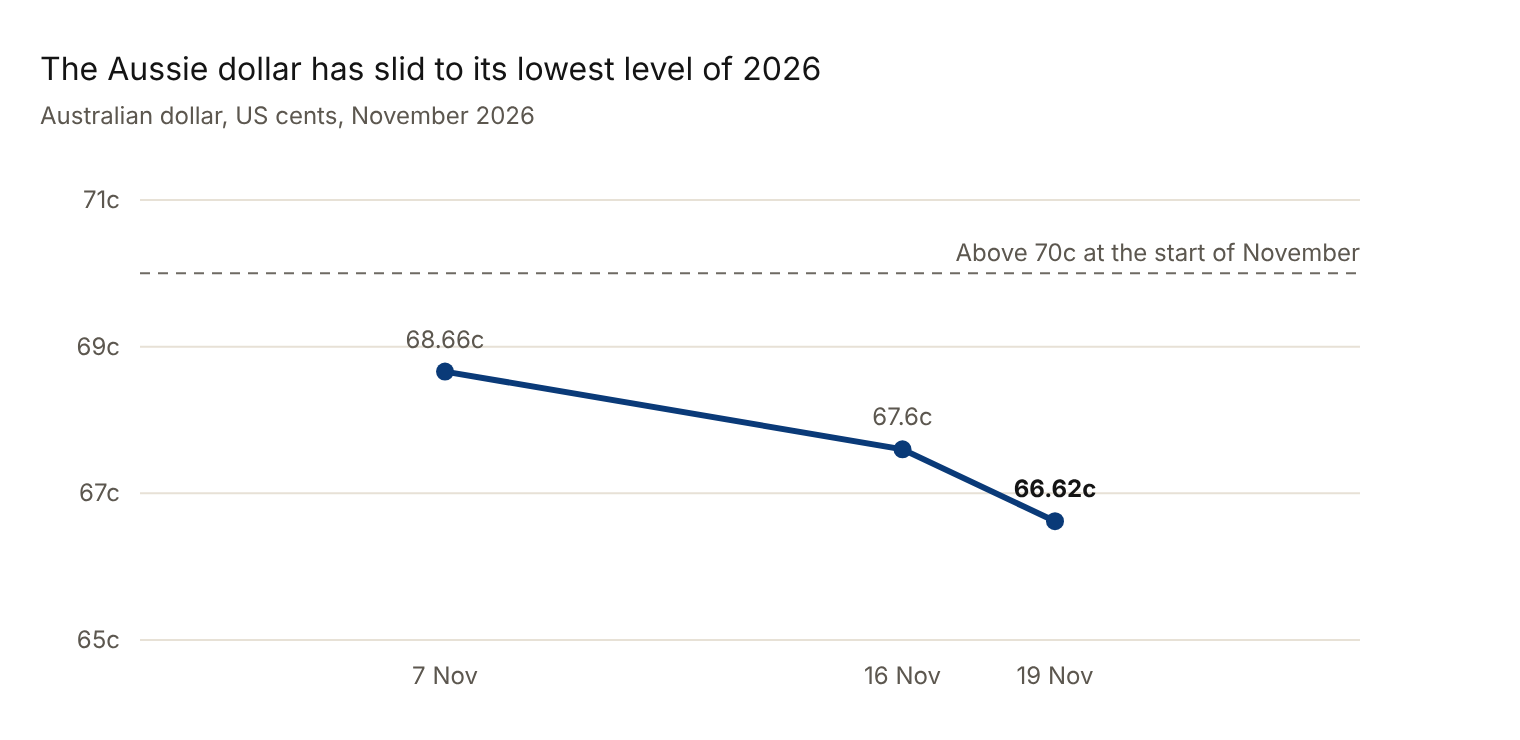
The Australian dollar has gone the other way. It started November above 70 US cents and has slid to its lowest level of the year, under 67 cents, after a drop of around 4.5 per cent in a matter of weeks. A cheaper Aussie softens some of the blow to royalties, as it did in 2015, but it did not save the budget then. It also cuts the other way: it makes imported fuel and goods dearer, adding to inflation in a city already paying more than Sydney and Melbourne.
The lights are going off in Perth's shopping centres
David Jones went into administration on 5 November, and its receivers say half of its 38 stores will close by the end of the year. Perth loses three of them: the Hay Street Mall flagship, Westfield Carousel and Westfield Booragoon.
Hay Street is the most significant closure in any capital city CBD. Business News reports the exit could leave around 91 per cent of the 24,000-square-metre building empty, right in the heart of a city centre the government has spent years trying to revive.
David Jones' problems are national and long in the making. That is precisely the point: Perth is not insulated from them. Ask the staff on the shop floor at Carousel whether this feels like an east coast problem.
Renters are already at the limit
For renters, the squeeze is even tighter. SGS Economics and Planning's Rental Affordability Index, released this week, found Perth is the least affordable capital city for renters for the third year in a row, with the average renting household spending 32 per cent of its income on rent. In 2020 that figure was about 21 per cent.
Spending 30 per cent or more of income on rent is the accepted line for rental stress, the point at which households start cutting back on essentials such as power, medicine, food and transport. Renters in Sydney spend about 30 per cent. In Melbourne it is 26 per cent. Perth is the outlier, and it is not an east coast problem.
The property safety net is fraying
For years, rising home values gave Perth households a cushion against everything else. That cushion is thinning fast.
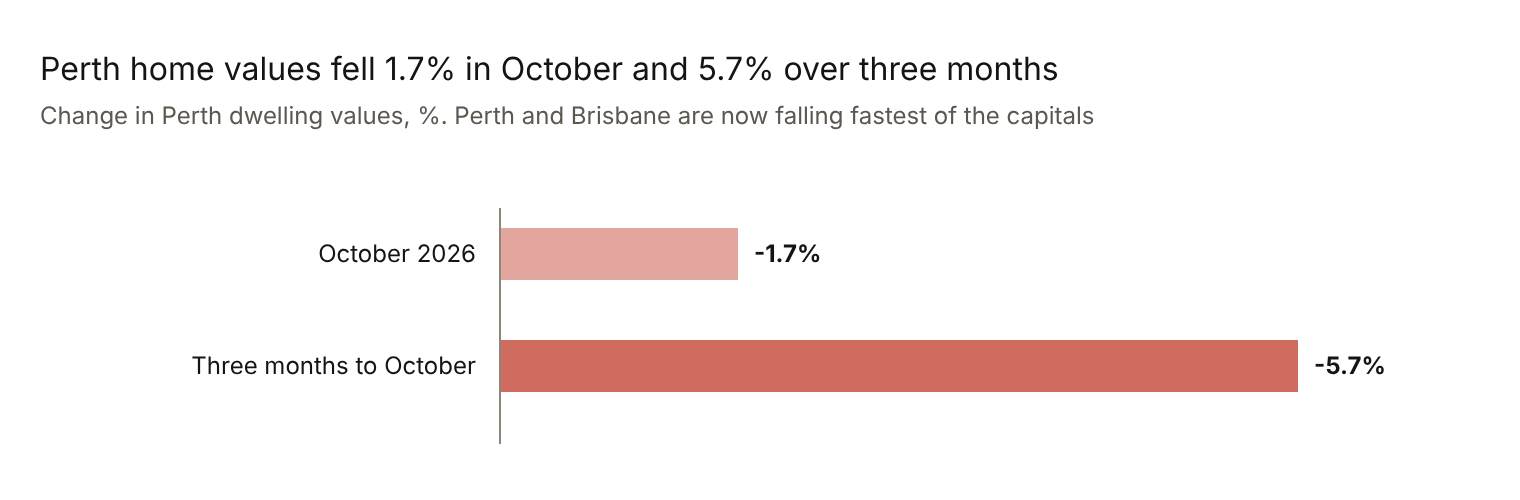
Cotality figures show Perth home values fell 1.7 per cent in October and 5.7 per cent over the past three months, with Perth and Brisbane now declining faster than any other capital. Cotality's research director, Tim Lawless, says almost every suburb across Perth, Brisbane and Adelaide has lost value over that period.
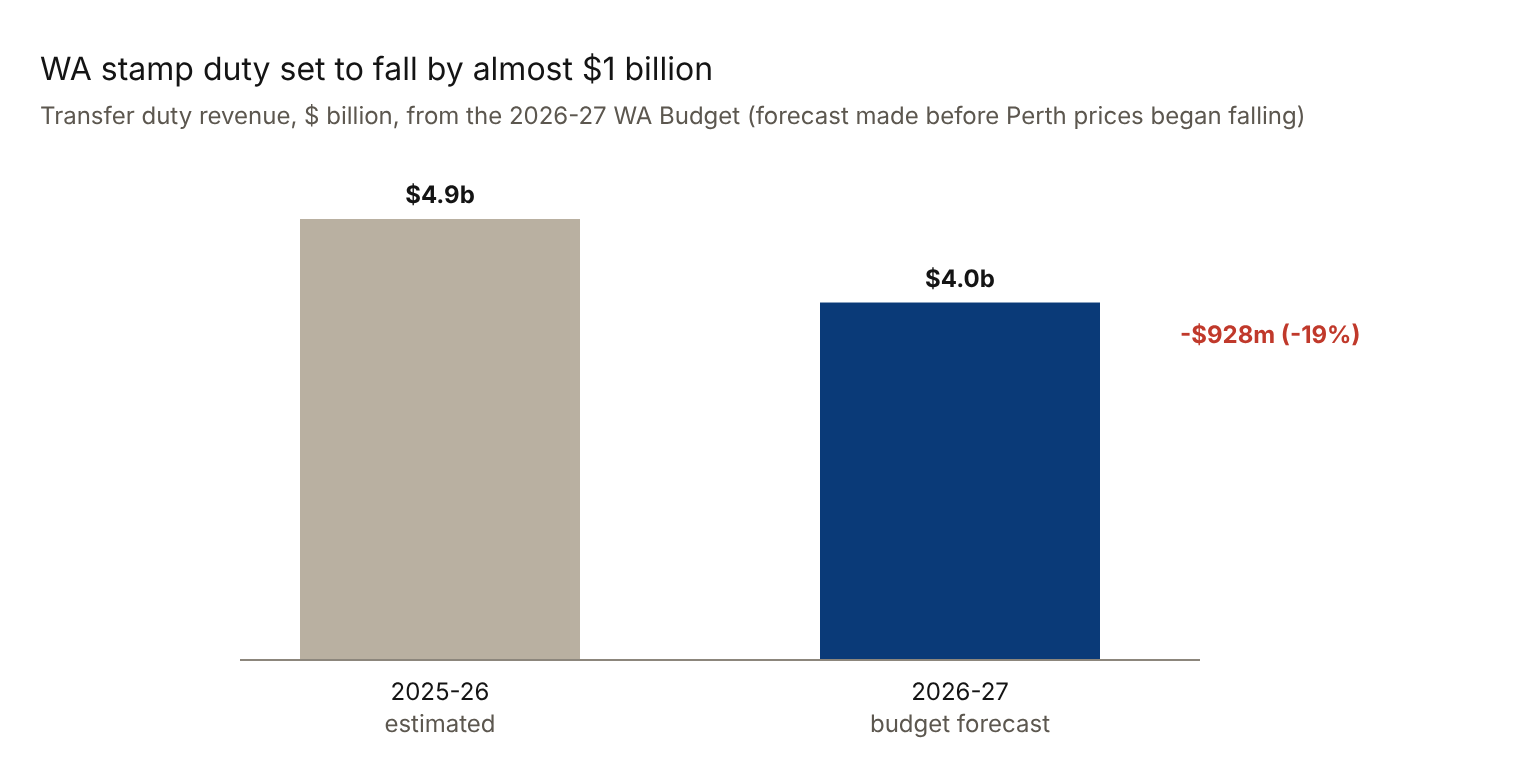
It also hits the Treasurer's own bottom line. Stamp duty has been one of the government's biggest windfalls, bringing in about $4.9 billion last financial year. Her own May budget already forecast it to fall 19 per cent this year, a hole of almost $1 billion ($928 million), and that was before Perth prices started falling faster than anywhere else in the country. A slide in property and a slide in iron ore together hit both of the state's biggest revenue sources at once. That is not an east coast problem either.
Put it together: prices rising faster than in Sydney or Melbourne, unemployment climbing, the state's biggest employers trimming staff, a landmark retailer pulling out of the CBD, and the family home worth less than it was in winter. That is how confidence breaks, which is the very thing the Treasurer says she wants to protect.
Confidence comes from candour
Saffioti is right about one thing. Confidence matters, and sometimes it does run ahead of, or behind, the facts.
But "blame the east" is one of the oldest tricks in WA politics. Governments of both colours have reached for it whenever the news turns bad. Even in 2015, as iron ore collapsed, the Barnett government called its deficit a perfect storm that showed the need for GST reform, pointing at Canberra rather than at its own reliance on royalties. Us-versus-them is a comfortable line. It is also a cop-out, because it lets a government skip the harder conversation about what it will do if the downturn arrives here.
Nobody perfected it like Mark McGowan. During COVID, his hard border kept WA sealed off from the rest of the country for almost two years, until it came down on 3 March 2022. Whatever you think of the health case, the politics were brutally effective: WA against the east, against Canberra, against Clive Palmer's High Court challenge. Labor won 53 of the 59 lower house seats in 2021 and reduced the Liberals to two. Saffioti sat at McGowan's cabinet table through all of it. She knows how well the east coast works as a villain.
But a border cannot keep out an iron ore price, a Chinese property slump or a rising US dollar. The pandemic playbook does not work on an economy.
But confidence is not built by telling people that what they can see with their own eyes is happening somewhere else. The renter paying more every month knows. The Pilbara worker who has just been told his role is gone knows. The retail assistant at Booragoon knows.
What West Australians need from their Treasurer is not reassurance but a plan: spending restraint that matches the rhetoric, a clear strategy for mining workers and towns if commodity prices keep sliding, a serious response to a hollowing CBD, and an honest account of what falling iron ore prices mean for the budget.
WA's fundamentals may have been strong. But fundamentals describe where an economy has been. Prices, jobs and house values describe where it is now, and right now, in Perth, all three are moving the wrong way.
Ryan Northover
PerthNews.Co opinion pieces reflect the views of the writer.
Perth headlines, business, property and what's on, every day at 11.59am.