WA Economy
Grave fears for Perth's economy and property market as job losses mount and BHP, Rio sink into a bear market
Iron ore is below US$90, China is stalling, copper has crashed and gold and lithium are in retreat. BHP and Rio are in a bear market, BHP and Woodside are cutting jobs, Perth house prices are falling fast and interest rates are at an 18-year high. Is WA heading for a repeat of 2015-16?
The week WA's miners cracked
The ASX 200 fell 5.4% this week to 8,592.6, its worst week in months, and the selling was led by the miners that pay WA's bills. On Monday alone, BHP, Rio Tinto and Fortescue accounted for 80% of the market value lost among the biggest stocks (Small Caps).
By Friday, the AFR reported that both BHP and Rio had entered a bear market, the term for a fall of 20% or more from a recent peak. Rio crossed that line last week, when it closed 23% below its June high (The Bull); it has fallen another 10% since. BHP closed on Friday at $51.40, down 13% for the week. For the gold miners' week, see our miners wrap.
| Company | Fri close | Week |
|---|---|---|
| Mineral Resources MIN | $38.69 | −17.9% |
| BHP BHP | $51.40 | −13.2% |
| Rio Tinto RIO | $135.05 | −9.9% |
| Fortescue FMG | $13.44 | −9.7% |
| Evolution Mining EVN | $10.36 | −21.6% |
| Northern Star NST | $21.95 | −14.2% |
| Liontown LTR | $0.56 | −14.6% |
| IGO IGO | $4.50 | −12.8% |
| PLS PLS | $2.62 | −8.4% |
Weekly change, Friday 13 to Friday 20 November close. Source: TradingView, ASX data.
Iron ore: China is buying less
Iron ore, WA's biggest export by far, has slipped below US$90 a tonne, its lowest level in nearly four years, as Chinese steel mills cut back on buying (BigMint). Chinese analysts at an industry conference last week said the price may have to fall to about US$80 before high-cost mines start cutting output and a floor forms (Bloomberg).
The reason is China. Data released on Monday showed its economy slowing on every front in October. Factory output grew 4.8%, below forecasts, retail sales rose just 0.4%, and investment in property development, the biggest user of steel, has fallen 21.6% this year (Quartz, citing China's statistics bureau). China's iron ore imports were about 5% lower in October than a year earlier (Discovery Alert).
Prices are also being squeezed by China's state-owned iron ore buyer, China Mineral Resources Group. Federal Resources Minister Madeleine King said in Perth last weekend she was concerned its deals with Australia's biggest miners would weigh on their earnings (Capital Brief).
Copper's AI crash hits BHP and Rio twice
Copper was meant to be BHP and Rio's growth story. Instead it fell into its own bear market on Friday, just ten weeks after a record high, as investors dumped bets on the artificial intelligence data-centre boom (Mining.com). That hurts more than it used to: copper now makes up 39% of Rio's underlying earnings, up from 25% a year earlier (Motley Fool).
No shelter in gold or lithium
The rest of WA's resources sector offered no cover. Gold had its worst week since March, down about 9%, and the Goldfields producers fell up to a fifth. Lithium prices have roughly halved since May, and Citi now says only three of Australia's six spodumene mines cover their costs at today's prices. We covered both this week: WA gold miners hammered as gold slides 15% in a month and WA gold and lithium boom party may be over.
Jobs: the cuts have started in Perth
The miners are not waiting. BHP is restructuring its Western Australia Iron Ore division, which is run from Perth and employs more than 16,000 staff and contractors, to strip out management layers and office-based support roles (IndexBox, citing Bloomberg). That follows about 300 site-based jobs already cut (ad-hoc-news).
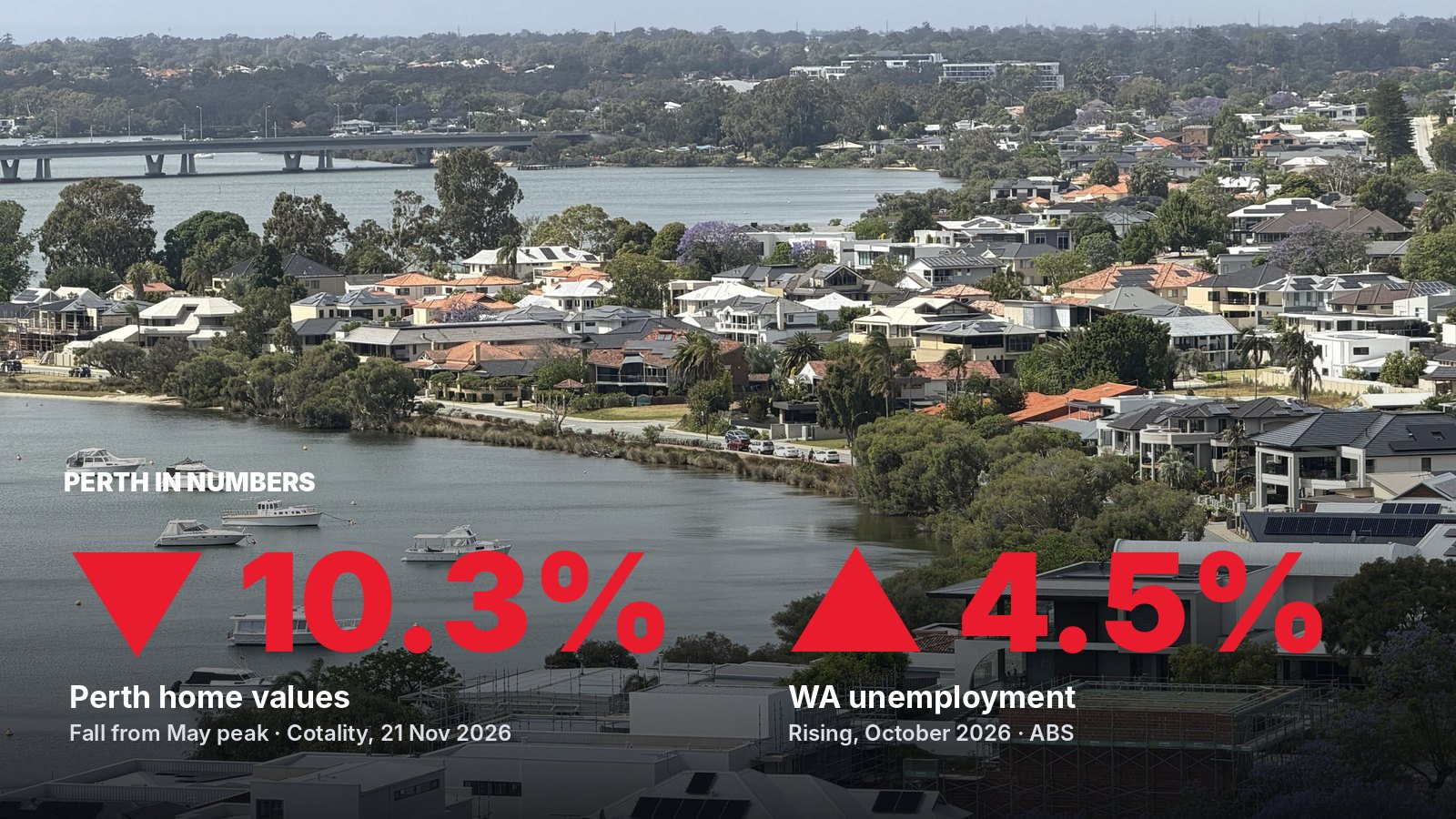
Woodside announced on 5 November it will cut more than 500 jobs, about a tenth of its workforce, to save US$400 million a year. About 80% of its people are based in Australia, mostly in WA, and Treasurer Rita Saffioti said she was "very disappointed" (ABC News). Hancock's Roy Hill cut jobs in June. And the cuts are already showing up in the numbers: WA's unemployment rate rose to 4.5% in October, while the national rate jumped to 4.9%, a five-year high. We covered the jobs figures in Fears for WA economy as job losses mount, Perth property plummets and in Friday's Briefing.
Property: Perth has gone from boom to bust
Six months ago Perth was the last housing market in the country still rising (we tracked the turn in our November WA economy report). It is now one of the fastest falling. On Cotality's daily index, Perth dwelling values are 10.3% below their peak in May, down 5.7% in the past three months and almost 2% in the past month alone. A year of gains has been all but wiped out: values are now just 0.3% higher than a year ago.
| City | 7 days | 30 days | 90 days | 1 year | From peak |
|---|---|---|---|---|---|
| Perth | −0.46% | −1.95% | −5.74% | +0.26% | −10.3% |
| Sydney | −0.45% | −1.66% | −4.59% | −10.94% | −11.3% |
| Melbourne | −0.20% | −0.72% | −2.40% | −8.34% | −8.4% |
| Brisbane | −0.70% | −2.56% | −6.08% | −2.67% | −9.6% |
| Adelaide | −0.51% | −1.65% | −4.22% | +1.86% | −5.6% |
| Five capitals | −0.45% | −1.67% | −4.58% | −6.88% | −9.4% |
Change in dwelling values to 21 November 2026. Source: Cotality daily home value index, compiled by @rabbit_wealth.
The pace is what worries economists. Perth's fall over the past month works out to an annualised rate of about 23%, second only to Brisbane, and values have not had a single rising day in the past 30. Only Sydney is further below its peak, and Sydney started falling months earlier.
Supply is flooding in. Homes for sale are running nearly 74% above this time last year (MacroBusiness, citing Cotality). REIWA counted 9,129 homes for sale at the end of October, more than triple the 2,880 a year earlier (Australian Property Experts, citing REIWA). After years of homes selling in days, buyers now have choice, time and bargaining power.
Rates are biting. The Reserve Bank lifted the cash rate to 4.85% on Melbourne Cup day, its fifth rise this year and the highest level since 2008 (Savings.com.au). Buyers who stretched to pay record prices in the first half of the year now face repayments far higher than they planned for, and the RBA has not ruled out more.
Jobs are the swing factor. A correction driven by interest rates tends to slow once rates stop rising. A correction driven by job losses is harder to stop, because forced sellers add to supply just as buyers lose confidence. That is the risk if the cuts at BHP, Woodside and their contractors spread. Rents, for now, are still rising and vacancies remain tight, which is keeping investors from selling in large numbers.
How far could it go? At the current pace, Perth values would be down more than 12% from their peak by Christmas (MacroBusiness). Even then, most Perth owners would still be well ahead: values more than doubled after the pandemic. The pain falls on recent buyers, those who borrowed heavily, and anyone who has to sell in a hurry.
Retail: David Jones and the empty shopfronts
Shoppers are already pulling back. David Jones went into administration this month after rent talks with Westfield broke down, and at least three of its Perth stores, at Carousel, Garden City and Karrinyup, are set to close, with the future of the CBD store uncertain (ABC News). Falling house prices tend to make households spend less, which would squeeze shops and restaurants further into 2027.
Is this 2015-16 again?
The last time WA's economy turned, it turned hard. Iron ore and oil both fell about 40% in 2015, and WA's domestic economy shrank for two years in a row (WA Treasury). The state was in recession through 2016 and 2017, Perth dwelling prices fell almost 7% from their mid-2015 peak and kept falling for years (Westpac), and Perth's unemployment rate climbed from the mid-4s to the mid-6s in a single year (Your Investment Property).
What is different. Iron ore bottomed at about US$40 a tonne in late 2015 (RBA Governor Glenn Stevens, via BIS); today it is more than double that, and still above the state budget's forecast. The budget is in surplus and WA holds a triple-A credit rating from both major agencies (PwC). And in 2015 the big shock was the end of a mine construction boom, which threw thousands of construction workers out of work at once.
What is worse. In 2015 the Reserve Bank was cutting interest rates to cushion the blow. This time it is raising them. Perth property is falling faster now than it did then, and the job cuts are reaching Perth head offices, not just mine sites.
Our read. As we wrote in our gold and lithium explainer, it is not 2015 yet. But for the first time in a decade, the ingredients are lining up: falling commodity prices, a slowing China, job cuts at WA's biggest employers, falling house prices and rising rates. The things to watch are iron ore holding above US$80, the RBA's next decision on 8 December, and whether BHP and Rio's cuts spread to contractors and suppliers.
What it means for you
The state budget. Iron ore royalties are WA's biggest single source of revenue. The 2026-27 budget assumed iron ore would average US$85.20 a tonne this financial year (WA Government). Every US$1 move in the price shifts the state's revenue by about $93 million a year (KPMG), so a slide to US$80 would leave a hole of around half a billion dollars.
Your super and shares. BHP, Rio and Fortescue are among the largest holdings in most Australian super funds, so this week's falls will show up on most Perth members' next statements.
Your home. If you are buying, there is more choice and more room to negotiate than at any time in years. If you are selling, expect to wait longer and price realistically.
WA miners, live
- Loading live prices…
ASX prices, delayed about 20 minutes.
For general information only. This is not financial advice.
Perth's business, property and markets news, plus what's on this weekend. Free, every Friday at 6am.