WA Economy
Fears for WA economy as job losses mount, Perth property plummets
Western Australia accounted for more than 40% of all the jobs Australia lost in October, despite being home to about one in ten Australians. About 19,000 West Australians lost work in a single month. At the same time iron ore is down 9% since September, lithium has nearly halved and Perth home values are falling at one of the fastest rates in the country. Only LNG is holding up, thanks to the war in the Gulf.
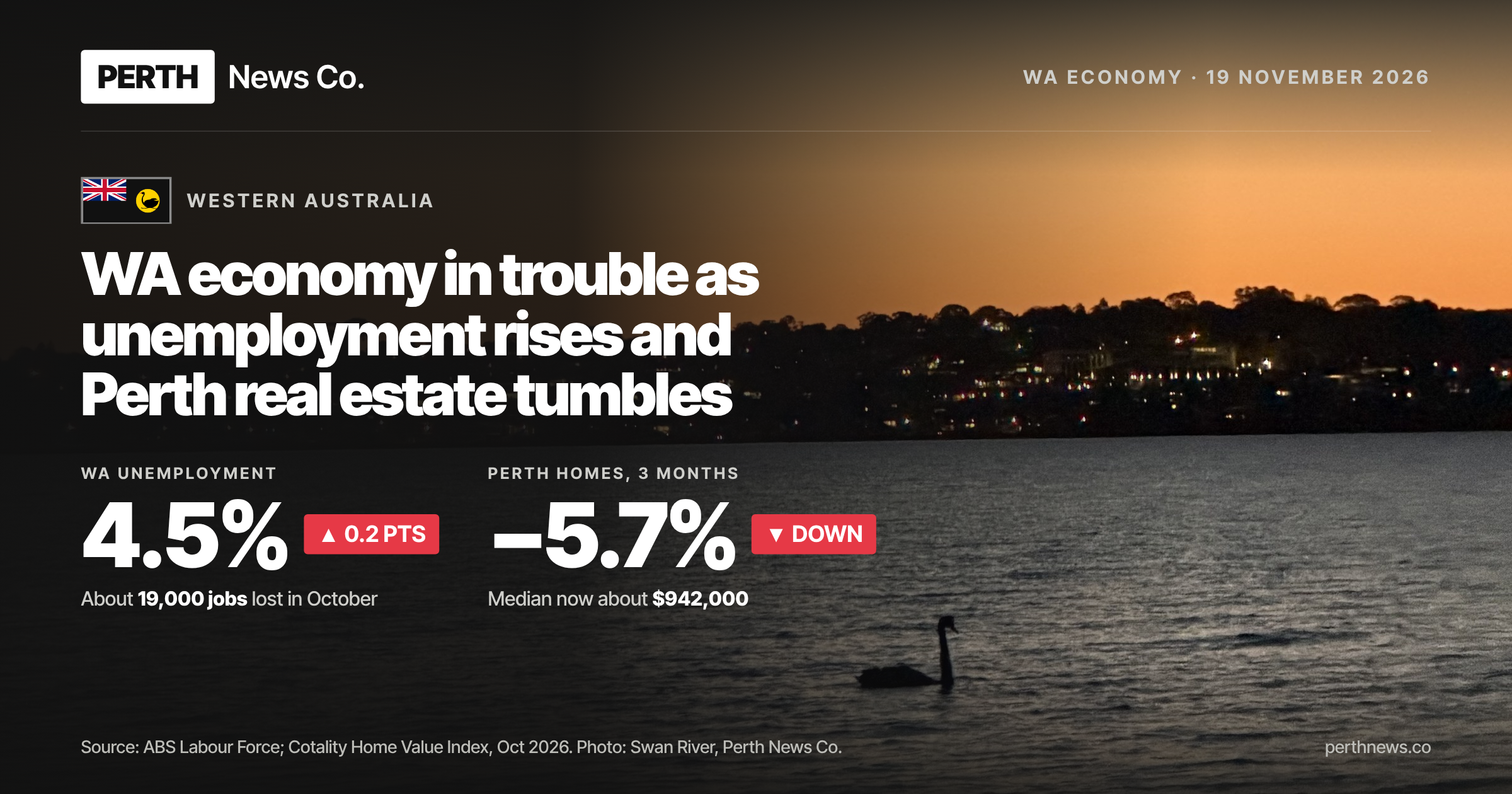
Australia lost 43,500 jobs in October. About 19,000 of them, more than 40%, were in Western Australia. No other state came close.
For three years Western Australia carried the national economy. Strong jobs numbers, record commodity exports and a property boom that led the country made WA the state everyone else envied.
Since September, almost every part of that picture has turned.
The WA scorecard since September
| Jobs | ▼ Down | About 80,000 West Australians out of work. Employment fell 1.1% in October (about 19,000 jobs), more than 40% of national job losses. BHP, Woodside and David Jones cutting jobs. |
| Property | ▼ Down | Perth values fell 1.7% in October and 5.7% over three months, leaving them up just 3.9% over the year. More falls forecast. |
| Iron ore | ▼ Down | About US$91/t, down 9% from about US$100/t in early September. A 12-month low. |
| Lithium | ▼ Down | Down 45%: from about US$2,250/t in early September to about US$1,240/t this week. |
| Gold | ▼ Down | About A$5,720/oz, down 5% since mid-October and 25% below its peak. |
| Grain | ▬ Solid | 23.9 million tonne harvest forecast, 12.5% below last year's record. |
| Aussie dollar | ▼ Down | About 66.75 US cents, down more than 5% since late October. Lowest since January. |
| LNG | ▲ Up | Asian spot prices around US$31/mmBtu, up about 200% on pre-conflict levels. |
Jobs, property, iron ore, gold and LNG: the week's numbers in a free 6am email. No paywall, no clickbait.
Jobs: 19,000 gone, and more than 40% of the national toll
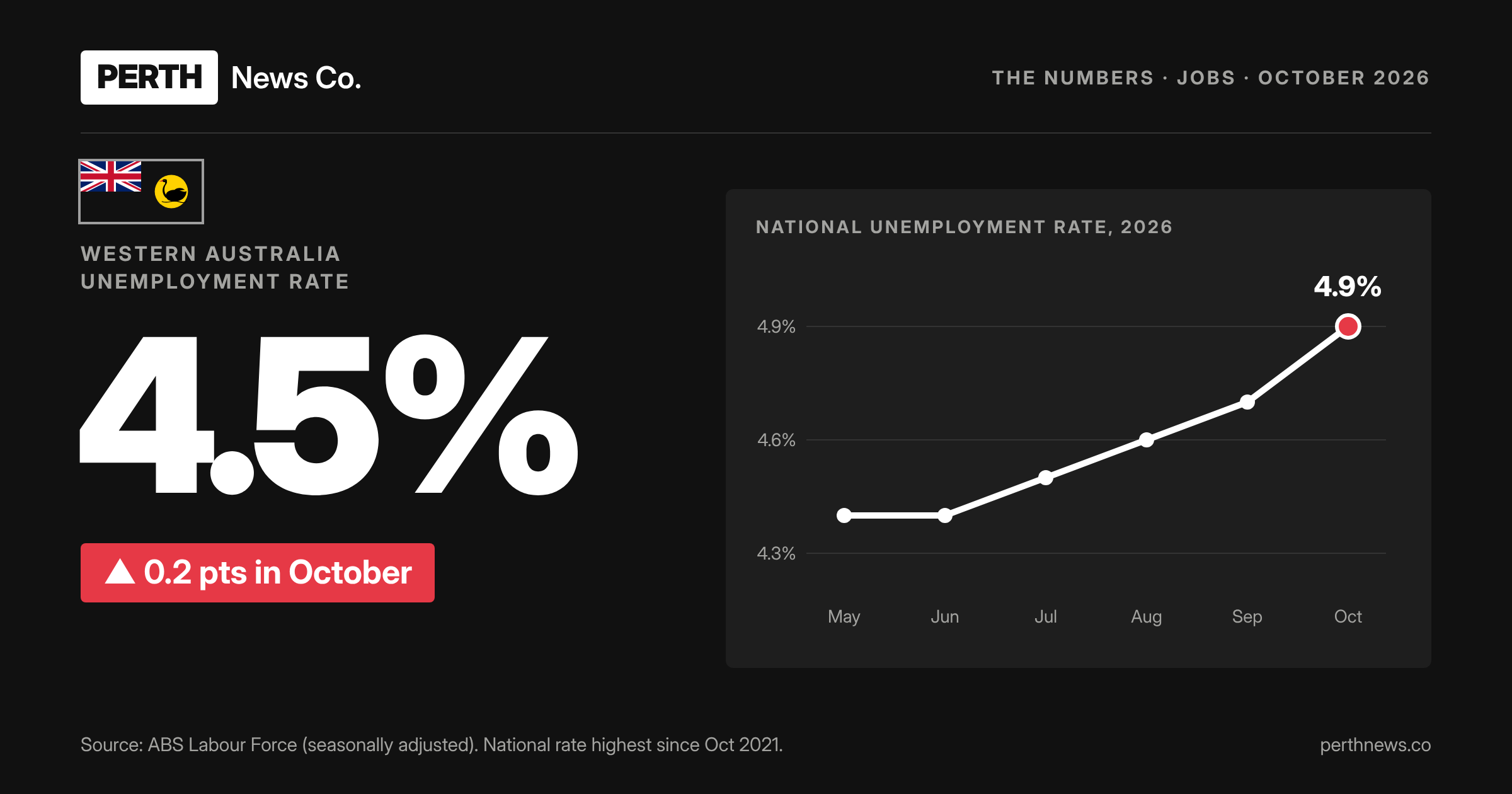
The headline from this morning's ABS labour force figures is national: Australia's unemployment rate jumped to 4.9% in October, the highest since October 2021, as 43,500 jobs disappeared across the country.
But the worst of it was here. WA's employment fell 1.1% in October, the biggest fall of any state. That's about 19,000 West Australians out of work in a single month. It means WA, with about a tenth of the nation's population, accounted for more than 40% of all the jobs Australia lost in October. The fall wiped out almost all of the 21,700 jobs the state added in September, when WA led the nation and total employment passed 1.7 million for the first time.
WA's unemployment rate rose to 4.5%. It is still technically the lowest of the states, but that is cold comfort when the direction has turned this sharply. Nationally, most of October's losses were part-time roles, a sign that businesses are cutting hours and casual staff first.
The Reserve Bank has raised interest rates several times this year, most recently earlier this month, to fight inflation. Every rise puts more pressure on household budgets and on businesses deciding whether to hire.
The job cuts are already landing
The October figures are not a statistical blip. Some of WA's biggest employers have announced cuts in the past six weeks.
BHP confirmed in mid-October it will cut about 300 jobs across its Pilbara iron ore mines at South Flank, Mining Area C, Jimblebar and Newman, as weaker iron ore prices and higher fuel and shipping costs squeeze margins.
Woodside, Australia's biggest oil and gas company, said on 5 November it will cut more than 500 jobs, about 10% of its workforce, to save US$400 million a year from 2028. Around 80% of Woodside's staff are in Australia, the vast majority in WA. Treasurer Rita Saffioti said she was very disappointed.
David Jones is shutting shop in Perth. After the 188-year-old department store went into administration this month, its receivers confirmed 19 stores will close nationally, including three in WA: Carousel, Garden City and the Hay Street Mall store in the CBD. They will trade until the end of December.
Those cuts come on top of earlier lay-offs in the iron ore industry this year. Many of the BHP and Woodside roles will take months to flow through, which means the job losses have further to run.
Property: the boom has rolled over
Perth was Australia's best-performing property market for most of the past five years. That run is over.
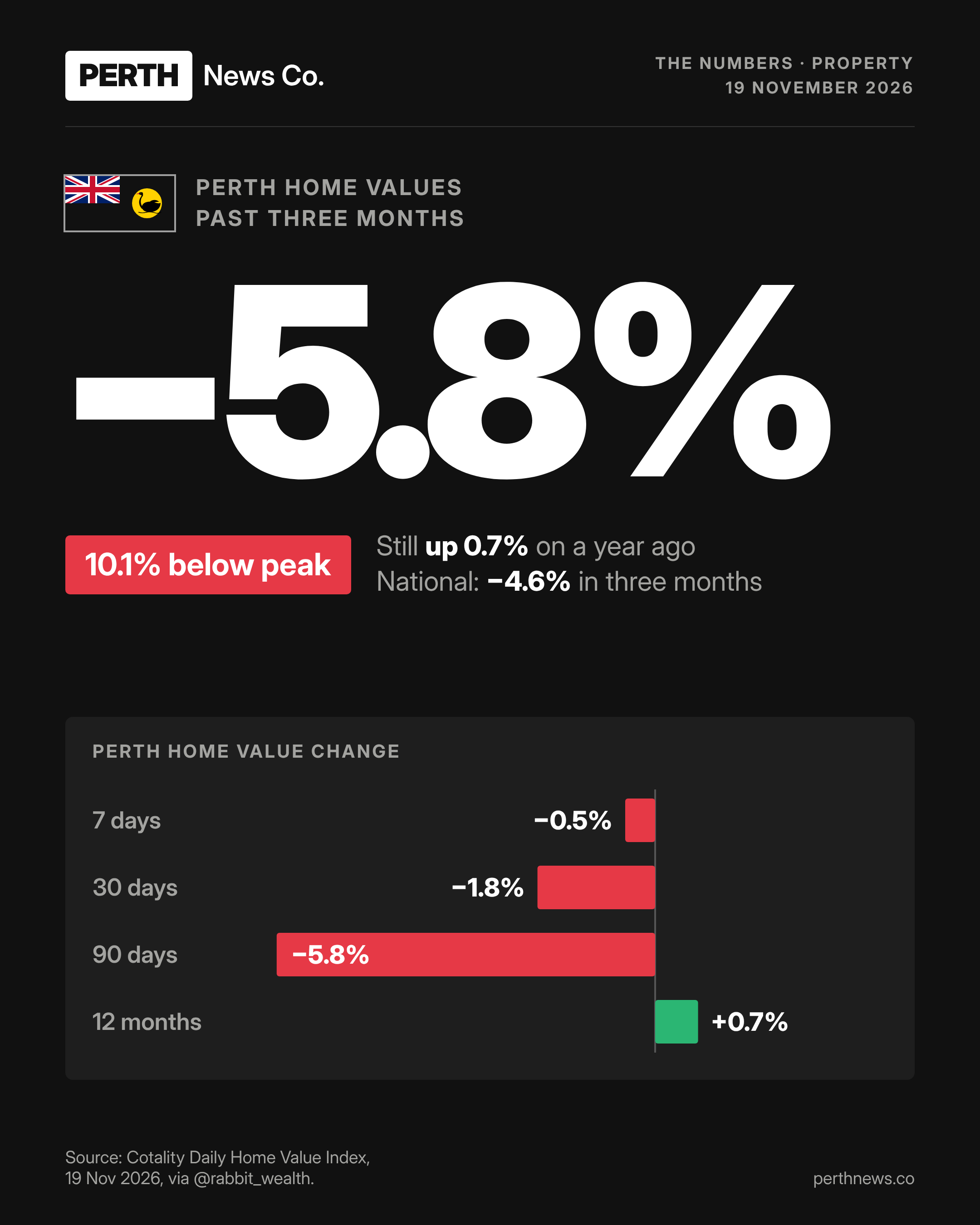
Cotality's latest Home Value Index shows Perth dwelling values fell 1.7% in October and 5.7% over the past three months. Only Brisbane is falling faster. Perth values had already fallen in September, a drop Cotality has since revised from 1.2% to 2.1%. At the end of September the median Perth dwelling was valued at about $975,000. By the end of October it had fallen to about $942,000, around $33,000 lower in a single month.
Nationally, values have now fallen for seven months in a row and are 6.7% below their March peak. Cotality says the downturn is on track to be the sharpest in at least 40 years. Home sales across the country are running about 23% below a year ago.
Higher rates and federal budget tax changes have pushed investors out of the market, and first-home buyers have pulled back too. Commonwealth Bank economists now expect Perth prices to fall 18% from their April peak before levelling out in the second half of 2027.
Expect more falls. Rising unemployment, job cuts at the state's biggest employers and higher interest rates all weigh on what buyers can borrow and what they are willing to pay. CBA is tipping a peak-to-trough fall of 18%, which means the forecasters see much of the decline still to come.
For buyers there is an upside: more homes on the market, more time to decide and more room to negotiate, if you're lucky enough to keep your job, that is. For anyone who bought near the top with a big mortgage, the picture is tougher.
Iron ore: near four-year lows
Iron ore is WA's biggest export by far, and its price is sliding. The benchmark 62% Fe price was about US$100 a tonne in early September. On Tuesday it was about US$90.60, down 9% and at a 12-month low. In China, iron ore futures fell to about CNY 640 a tonne, close to their lowest level in four years.
The reasons are stacking up. China's steel output fell to its lowest level since March in October, so mills need less ore. Stockpiles at Chinese ports are building. Guinea's giant Simandou mine, a long-term rival to the Pilbara, is ramping up production. And Beijing is now negotiating iron ore prices through one centralised state buyer, China Mineral Resources Group, which gives it more bargaining power over WA's miners. Australia's Resources Minister said this week those negotiations could potentially breach international trade rules.
Lower iron ore prices hit the profits of BHP, Rio Tinto and Fortescue, and flow directly into the state budget through royalties.
Lithium: the rally is over
Lithium was this year's comeback story. Spodumene, the lithium concentrate WA's mines produce, climbed to about US$2,250 a tonne in early September, more than triple its level a year earlier.
That rally has unwound fast. An Albemarle spodumene auction on Tuesday sold at about US$1,240 a tonne, a fall of about 45% in around ten weeks. Higher prices earlier in the year encouraged miners to restart idle operations, including Mineral Resources' Bald Hill mine near Kambalda, and that new supply is now pushing prices down.
Gold: off the boil
Gold has been a quiet hero for WA's Goldfields and for local investors. It is still historically high, but it is falling. The Australian dollar gold price was about A$5,720 an ounce on 13 November. That is down almost 5% from about A$6,000 in mid-October, and about 25% below its high of about A$7,600 in the past year.
Grain: a good season, not a record
The Wheatbelt has had a better finish than expected. The Grain Industry Association of WA's October crop report forecasts a total harvest of 23.9 million tonnes, up from 21 million in August, after late-winter rain and a mild spring helped crops fill.
Wheat is forecast at 10.9 million tonnes, barley at 6.8 million and canola at 4.6 million. That is a solid result, but about 3.5 million tonnes, or 12.5%, below last year's record 27.35 million tonne harvest.
LNG: held up by the war in the Gulf
WA's gas exporters are the only exception, and that is thanks to the war in the Gulf. Since the US and Israeli strikes on Iran in late February, the Strait of Hormuz has been effectively closed to most shipping. About a fifth of the world's LNG used to pass through it, and Qatar, one of the world's biggest exporters, has lost most of its shipments.
The result: spot LNG cargoes for North Asia were priced at US$31.30 per million British thermal units in the week to 13 November, near a four-year high and roughly triple (up about 200%) the level before the strikes. That is a windfall for WA's LNG projects and the companies behind them.
But it is a windfall built on a war. Any easing of tensions in the Middle East, or a return of Qatari supply, would bring prices down quickly. High prices are also already putting off price-sensitive buyers, with China importing less LNG than a year ago.
The Aussie dollar: rolled over
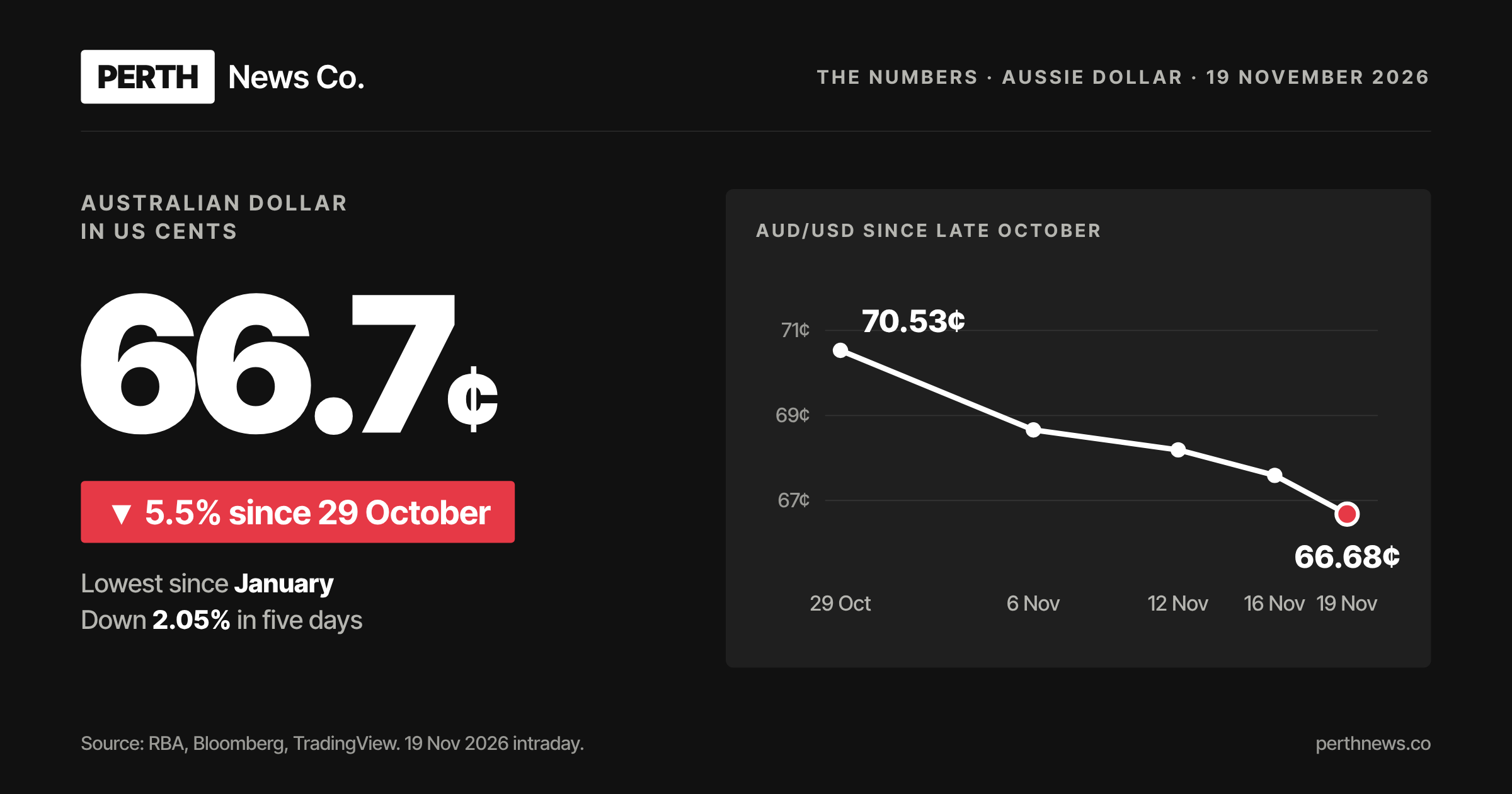
The Australian dollar has rolled over too. It was worth about 70.5 US cents at the end of October. Today it slid to about 66.75 US cents, its lowest since January, after the weak jobs figures convinced markets the Reserve Bank has finished raising rates and will cut next year. That fall of more than 5% in three weeks has almost wiped out the dollar's gains for 2026.
A weaker dollar does ease some of the pain for WA's exporters. Iron ore, gold, lithium and LNG are sold in US dollars, so each US dollar they earn is now worth more in Australian dollars.
For households it is a different story. A weaker dollar makes imported goods and fuel dearer, which feeds straight back into inflation, already running well above the Reserve Bank's target. And anyone planning a holiday overseas this summer will find their money doesn't go as far.
WA's biggest stocks, today
How the market is pricing all this. Prices for WA's biggest listed companies, updated through the trading day (delayed 20 minutes).
The bottom line
WA is still in better shape than most of the country, but the gap is closing fast. Jobs are falling, house prices are falling, and iron ore, lithium and gold are all lower than they were in September. Right now only LNG is holding up, and only because of the war in the Gulf. If that conflict eases, WA loses its last cushion.
The next jobs figures are due in mid-December. If WA loses jobs for a second straight month, this stops being a blip and becomes a trend.
Perth's business, property and markets news, plus what's on this weekend. Free, every Friday at 6am.
Sources
- ABS, Labour Force, Australia, October 2026
- Cotality, Home Value Index, October 2026
- Grain Industry Association of WA, October 2026 Crop Report (via Grain Central)
- ABC News (BHP, Woodside, David Jones); SBS/AAP (David Jones closure list)
- Bloomberg and Switzer (Australian dollar)
- Investing.com, Rio Times and Trading Economics (iron ore); Shanghai Metals Market and Benchmark Mineral Intelligence (lithium); goldpricedata.com (gold); Reuters and Kpler (LNG)