Economy
Australia's private sector shrinks at the fastest pace in five years. Can WA hold out?
Business activity across Australia fell in November at the sharpest rate since the 2021 lockdowns, new orders dried up and firms started shedding staff. WA is still the strongest state for business conditions, but it is no longer immune, and the numbers out of Perth have started to turn.
What the survey found
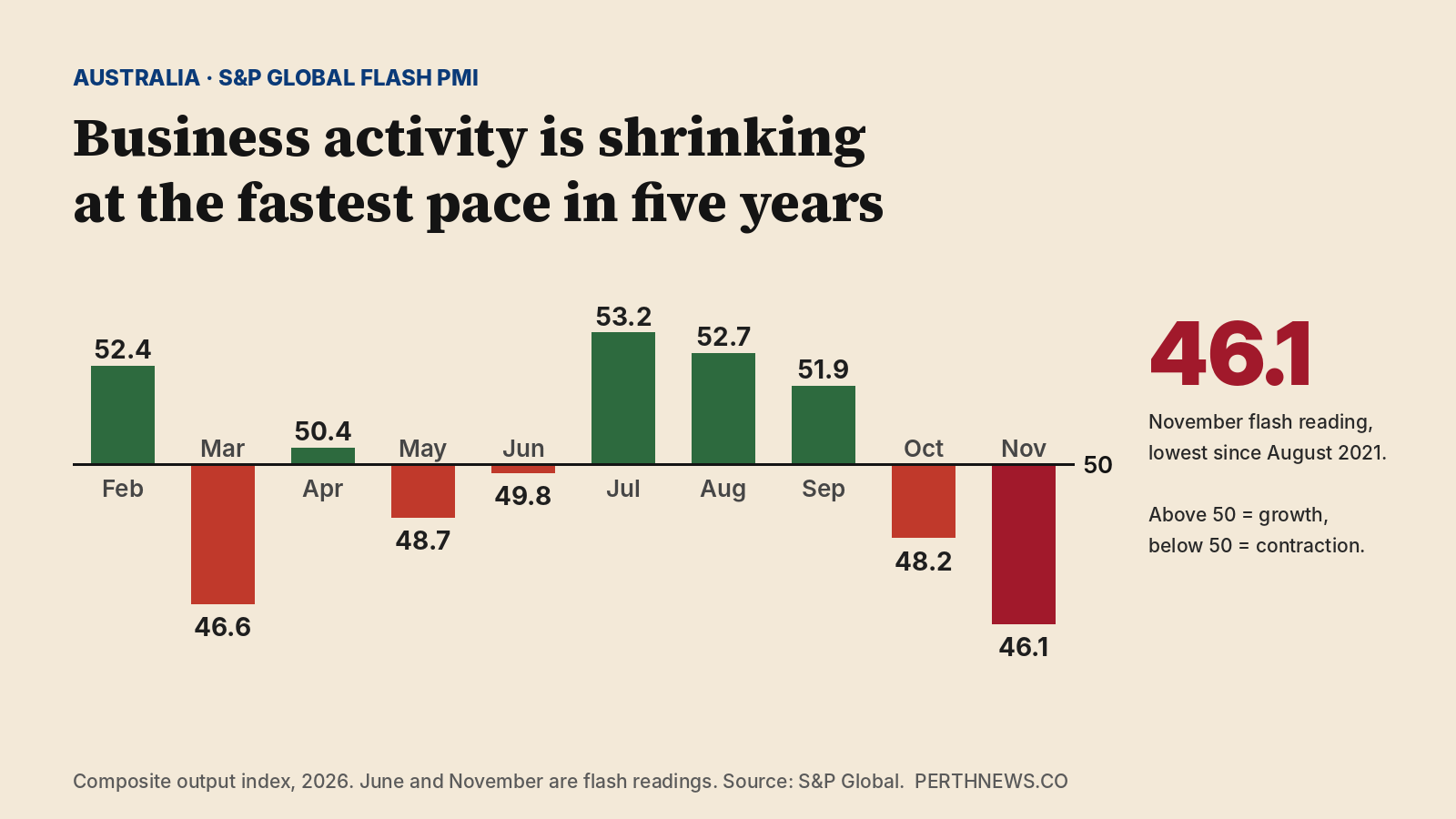
S&P Global's flash purchasing managers' index (PMI), an early read on the economy built from monthly surveys of around 800 manufacturers and service businesses, fell to 46.1 in November from 48.2 in October (S&P Global). Any reading below 50 means activity is shrinking, and this is the second month in a row below that line. It is the weakest result since August 2021, when Sydney and Melbourne were in lockdown.
Both halves of the economy went backwards. The services index dropped to 46.2 from 48.5, and manufacturing output to 45.3 from 46.2. S&P Global says the falls in each were the steepest in 36 and 25 months respectively.
The forward-looking parts of the survey were worse. New business fell for the first time in five months and at the fastest rate since August 2021, with services joining factories in decline. Export orders shrank at the sharpest pace in just over two years. Firms blamed weak economic conditions, tight budgets and higher interest rates for customers holding back.
That is now flowing through to jobs and sentiment. With work drying up, businesses reported spare capacity and resumed cutting staff, and optimism about the year ahead fell to a three-year low.
November flash PMI
| Composite output | 46.1 | Down from 48.2. Lowest since August 2021. |
| Services activity | 46.2 | Down from 48.5. Steepest fall in 36 months. |
| Manufacturing output | 45.3 | Down from 46.2. Steepest fall in 25 months. |
| Manufacturing PMI | 48.7 | Down from 49.6. |
| Prices | Easing | Input cost and selling price inflation both softened as demand weakened. |
There is one silver lining. As demand weakened, the rates at which firms' costs and selling prices are rising both eased. That matters ahead of Wednesday's inflation figures and the Reserve Bank's meeting on 8 December.
Is WA different?
The PMI does not break the numbers down by state, so the best guide to WA is the NAB Monthly Business Survey. Until recently it told a very different story here. In September, NAB said WA was "the clear outlier", with trend business conditions at +16 while New South Wales, Victoria and Queensland hovered around zero (NAB).
October was the first real crack. WA business conditions fell 11 points in a month on NAB's seasonally adjusted measure, from +17 to +6, the biggest fall of any state. Confidence in WA dropped to -14, and across the country NAB's forward orders measure plunged 11 points, which it read as a sign of tougher trading ahead (NAB October survey). WA's trend conditions, at +10, are still the second-best in the country behind Tasmania, but the gap is closing.
| State | Conditions | Confidence |
|---|---|---|
| WA | +10 | -11 |
| Tasmania | +20 | +1 |
| SA/NT | +1 | -19 |
| Queensland | -1 | -13 |
| NSW/ACT | -2 | -15 |
| Victoria | -6 | -12 |
| Australia | -2 | -15 |
Trend net balance, October 2026. Source: NAB Monthly Business Survey.
WA's own business chamber found a similar mix of resilience and strain. CCIWA's September-quarter survey showed 40% of WA businesses expect conditions to improve over the next year, up 15 points from June. But 80% named rising costs as a barrier to growth, the highest share since CCIWA started asking in 2021, led by retail, resources and construction, and 56% still reported skilled labour shortages (CCIWA). Chief economist Dr Daniel Kiely warned that confidence remained in negative territory on CCIWA's longer-term index.
That survey was taken before the latest run of bad news: the November rate rise, the slump in iron ore and copper, and job cuts at BHP and Woodside. We covered those in our report on the pressure building on Perth's economy.
Why it matters for Perth
Jobs. The PMI's warning on staffing lines up with what is happening here. WA unemployment rose to 4.5% in October, and the cuts have reached Perth head offices, not just mine sites.
Property. Perth home values are already more than 10% below their May peak. A weaker job market is the biggest risk to a quick recovery, because forced sellers add to a market already flooded with listings.
Rates. The PMI is the clearest sign yet that higher rates are biting. Whether the RBA hikes again on 8 December now hangs on Wednesday's October inflation numbers. Softer price pressures in the PMI would strengthen the case for holding, but economists expect headline inflation to rise.
Our read
For most of 2026, WA business has been the exception to a national slowdown, carried by mining and big projects. The November PMI suggests the rest of the country is now going backwards quickly, and October's NAB survey shows WA is starting to feel it too. WA still has the stronger hand, but the margin is narrowing.
Three things to watch: Wednesday's inflation figures, NAB's November business survey in early December, and CCIWA's December-quarter survey, which will be the first WA read taken after the rate rise and the mining job cuts.
Sources
- S&P Global, Flash Australia PMI, November 2026
- NAB Monthly Business Survey, October 2026 and September 2026
- CCIWA Business Confidence Survey, September quarter 2026
For general information only. This is not financial advice.
Perth headlines, business, property and what's on, every day at 11.59am.