Opinion
Who decides what you see online? WA senator doubles down, and her example is a stay-at-home mum zesting lemons
Ellie Whiteaker's attack on "tradwife" videos shows what Labor's Digital Duty of Care could become
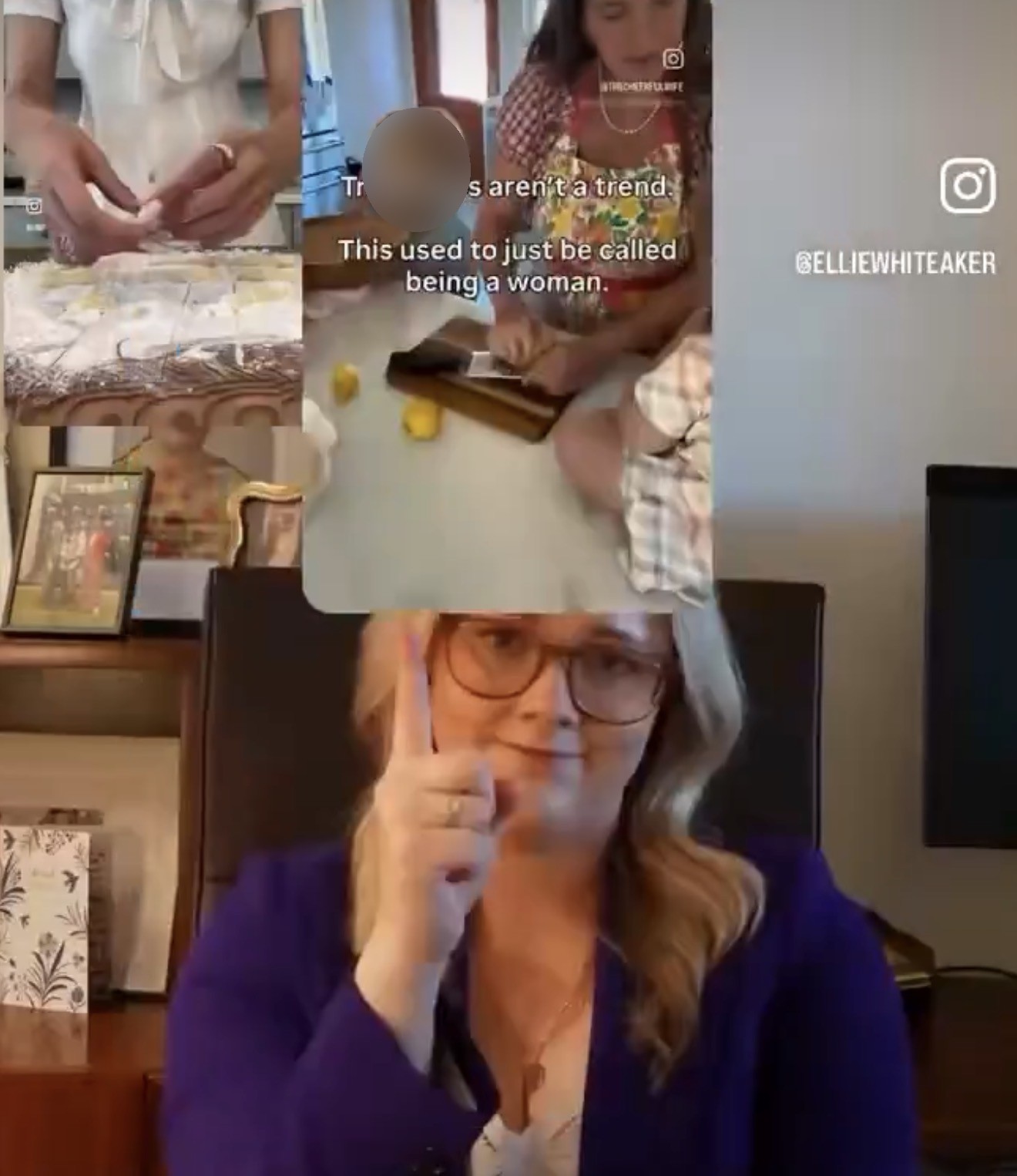
A woman zesting lemons in her kitchen with a toddler at her feet isn't most people's idea of an online threat. West Australian Labor Senator Ellie Whiteaker sees it differently.
Last week Senator Whiteaker posted a video arguing that young women shouldn't be exposed to "tradwife" content, calling it unsafe and proof that Australians need tighter internet regulation. Her examples were hardly extreme. One showed a woman cutting a cake for her "spicy snack" of a husband. Another, of a mother zesting lemons beside her toddler, was captioned "Trad wives aren't a trend. This used to just be called being a woman."
She didn't back down. Speaking in the Senate on Monday, she repeated the argument from her video: a clip of "a woman making a nice meal for her family" can lead, a few videos later, to content saying "a wife should obey her husband". She said young women deserve to trust "that they are not being sent down a rabbit hole online". She also turned on her critics, declaring the government "won't be bullied by those opposite, who are using this as a way to score cheap political points", and calling Victorian Liberal Senator Sarah Henderson "the failed member for Corangamite".
Why it matters
Her video is more than a social media spat. It's a sales pitch for Labor's Online Safety Amendment (Digital Duty of Care) Bill. The bill passed the lower house in late October but stalled in the Senate, leading to a snap inquiry.
Coalition senators, including WA's own Dean Smith, seized on the video in their dissenting report. They said her suggestion that women be shielded from lawful content about marriage and family life "goes to the heart of the dangers posed by this bill", and that the bill "creates powerful incentives to suppress lawful speech, including legitimate political debate".
That's the real worry. The bill hands the eSafety Commissioner and big tech platforms the job of deciding what counts as "harm". Platforms facing penalties of up to $109.2 million won't take chances. If a sitting senator thinks a mum baking a cake belongs on the harmful side of that line, it's fair to ask where the line will end up.
Weak evidence
To back her case, Senator Whiteaker told the Senate: "Research at the University of Pennsylvania found that tradwife content can be a pipeline into dangerous ideology that includes 'women should submit to men' and that it leads to an increase in tolerance for violence against women." She didn't name the study. The most likely candidate is The Rage of Tradwives, a Penn Annenberg paper published in the academic journal Feminist Theory.
It isn't the kind of study her claim needs. The researchers looked at 50 tradwife accounts on Instagram and TikTok, picked because they openly promote traditional gender roles, and gave their reading of what the posts express. They didn't randomly sample, run experiments, track viewers over time or measure how anyone was affected by watching. The paper's own abstract presents it as an argument about the creators' anger, which it says leads to "individual retreat rather than collective change". It makes no claim about viewers, a pipeline, or violence against women.
Even researchers in the field say the evidence base is thin. Another recent study of tradwife culture noted that most work on the topic analyses the content itself, and that hard empirical research is scarce.
The "rabbit hole" idea is also shakier than the senator suggests. Researchers at Penn's own Computational Social Science Lab found that YouTube's recommendation algorithm may not be the radicalisation pipeline earlier research suggested, and a separate study of real users found YouTube's algorithms weren't sending people down rabbit holes in 2020. Those studies looked at political content on YouTube, not tradwife videos on TikTok. Still, they're a long way from the clear-cut pipeline she described.
A view from inside the machine
Some context on the senator is relevant. Before entering parliament, Whiteaker worked as a campaign organiser for UnionsWA, an organiser for the AMWU and an adviser to Labor Senator Louise Pratt. She then became WA Labor's Assistant State Secretary and later State Secretary, before taking her Senate seat in July 2025. Every role in her published career record has been with a union, the Labor Party or a Labor politician. Nothing on the public record shows research or professional work in online safety, psychology or media.
There's nothing wrong with a life in politics. But many Perth families, including two-income households, small business owners and parents who've chosen to stay home with young kids, may wonder why someone who has spent her whole career inside the party gets to judge how they talk about their own family lives online.
The bottom line
On the same day Senator Whiteaker was defending her tradwife video, Treasurer Jim Chalmers was warning parliament of a tougher 2027. He said next month's mid-year budget update will show the economy "will be smaller than Treasury forecast in May". Unemployment is expected to peak above 5 per cent, inflation to stay in the mid-threes until the middle of next year, and the budget to slide into "bigger deficits in the later years".
With households bracing for that, many West Australians might wonder why a senator's energy is going into which cooking videos they see.
Labor says the Digital Duty of Care is about protecting Australians from genuine harm online. A senator using lawful content about marriage and motherhood as her example of that harm, and backing it with a study that doesn't say what she claims, undercuts that promise. If the government wants Australians to trust this bill, it might start by explaining why a woman zesting lemons was on the list, and which study it's relying on.
In the end, it comes down to a simple question for voters. Do you want the government deciding what you can and can't see online, or do you trust yourself to judge for yourself? On this evidence, the government seems to think you might not be up to it.
PerthNews.Co opinion pieces reflect the views of the writer.
Sources: Senate Hansard, 23 November 2026; Banet-Weiser & Reinis, "The rage of tradwives", Feminist Theory 27(1), 2026.
Perth headlines, business, property and what's on, every day at 11.59am.