Property
Perth's property boom is over: values underwater for the year as rates, inflation and negative gearing changes bite
Five rate rises, the highest inflation of any capital and the end of negative gearing for established homes have turned Australia's hottest market into one of its fastest-falling.
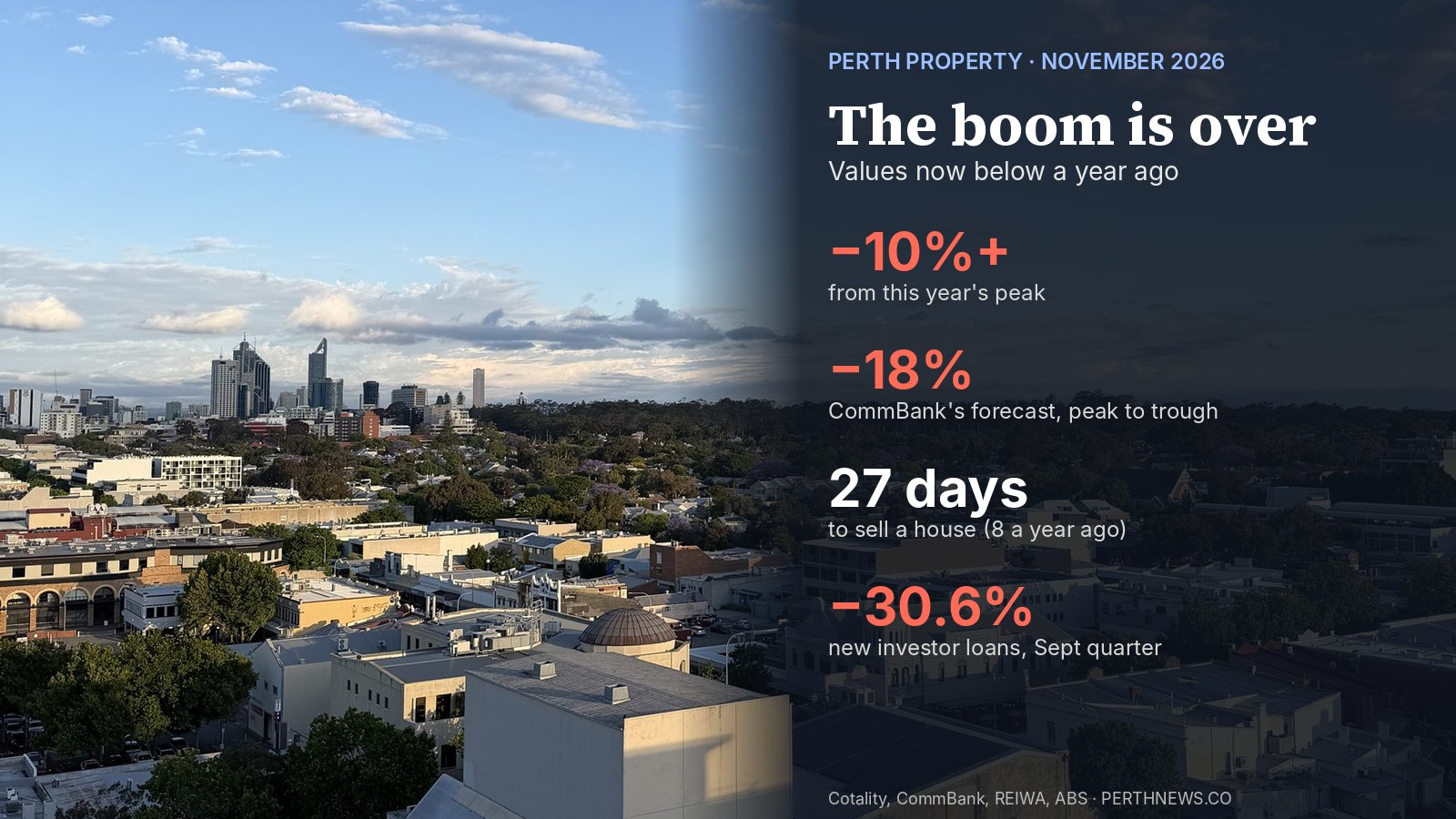
A year of gains has been wiped out. On Cotality's daily home value index, Perth dwelling values slipped below their level of 12 months earlier on 23 November, after falling more than 10% from their peak in the first half of the year. Over the past three months, only Brisbane has fallen faster.
The banks think there is further to go. CommBank's economists now expect Perth values to fall 18% from peak to trough. Nationally, they have lifted their forecast fall to 14%, up from 9% in September, which would be the biggest housing downturn on record.
What turned Australia's hottest market so quickly? Three things hit at once: higher interest rates, the highest inflation of any capital city, and the end of negative gearing for established homes.
| Perth property, by the numbers | |
|---|---|
| Annual change in dwelling values (Cotality daily index, 23 Nov) | Below a year ago |
| Fall over the three months to October (Cotality) | −5.7% |
| CommBank forecast, peak to trough | −18% |
| Cash rate (fifth rise of 2026) | 4.85% |
| Perth inflation, year to October | 5.5% |
| New investor loans, September quarter (national) | −30.6% |
| Median time to sell a house, October (REIWA) | 27 days (8 a year ago) |
| Homes for sale, week to 22 Nov (REIWA) | 9,884 |
| Sales that week (REIWA) | 610 |
Rates: five rises this year
The Reserve Bank lifted the cash rate to 4.85% on Melbourne Cup Day, its fifth increase this year and the highest level since 2008.
That has hit buyers hard in a city that had only just caught up with the rest of the country on prices. Housing affordability in WA was already at its lowest on record in the June quarter, when the typical family needed 47.5% of its income to meet loan repayments, according to the Real Estate Institute of Australia. Rates have gone up twice more since then.
Inflation: Perth is running hottest
Perth consumer prices rose 5.5% in the year to October, faster than Sydney (5.1%), Melbourne (4.4%) and the national rate (4.9%). Rents, power, fuel and insurance are all eating into the money households have left for a mortgage, and a number that high puts another rate rise firmly on the table when the RBA meets on 8 December.
Negative gearing: the investors have gone
The third blow came from Canberra. In the May Budget, the Federal Government ended negative gearing for established homes. Investors who buy an existing property after 7.30pm on Budget night, 12 May, can no longer offset rental losses against their wages from 1 July 2027. Properties already held are grandfathered, new builds keep the concession, and the 50% capital gains tax discount is being replaced by indexation. The changes became law on 26 June.
Investors have voted with their feet. New lending to investors fell 30.6% nationally in the September quarter to 35,301 loans, and the value of that lending fell 32.3% to $24.7 billion. The ABS says both are the largest quarterly falls on record. In WA, new investor loans fell about 30%, according to REIWA.
REIWA President Rob Mandanici has put the turn in the market down to a mix of consumer sentiment, the rate rises and the changes to negative gearing and the capital gains tax discount. "You should never underestimate the effect consumer sentiment can have on a market," he said.
More sellers than buyers
The result is a market with far more stock than buyers. REIWA members reported 9,884 homes for sale in Perth at the end of the week to 22 November, and just 610 sales. Earlier this month REIWA said spring sales had dropped to levels last seen in 2019.
Homes are also sitting on the market far longer. Perth houses took a median of 27 days to sell in October, up from eight days a year earlier, and units took 28 days, up from eight. Some suburbs are still moving quickly: houses in Wembley Downs and Kingsley sold in a median of nine days in October, and in Floreat in 11.
More choice and more time are good news for buyers, and our earlier story set out how quickly the numbers have turned.
Renters squeezed from both sides
Fewer investors means fewer new rentals over time, and WA leans on investors more than most: REIWA says they supply more than 86% of the state's private rental homes. Perth's vacancy rate is down to 1.6%, well below the 2.5% to 3.5% that REIWA considers a balanced market. Rental listings have started to rise, up 12.7% on a year ago, but the average Perth renter is still spending 32% of their income on rent, making Perth the least affordable capital for renters.
What it means
If you own: most Perth owners are still well ahead after values roughly doubled following the pandemic. The risk is for those who bought near the peak with a small deposit, who may now owe more than their home is worth.
If you are buying: there is more choice, more time and more room to negotiate than at any point in years. Trying to pick the bottom of the market is hard, so buy for the long term.
If you invest: an established home bought now has to pay its way on rent alone once the new rules start. New builds are the only place left to negatively gear.
Our read
Perth's boom was the last to start and one of the biggest. It is ending just as quickly. A downturn driven by rates usually eases once rates stop rising, but this one has a tax change and a softening jobs market behind it too. Whether the slide slows in the new year depends on the RBA on 8 December, and on whether the mining job cuts spread.
Sources
Cotality daily home value index (23 November 2026) and monthly index (October 2026); CommBank economists' housing forecast (3 November 2026); ABS Lending Indicators, September quarter 2026; REIWA weekly market snapshot (week ending 22 November 2026), October market update (time on market), vacancy rate and market updates; Real Estate Institute of Australia Housing Affordability Report (June quarter 2026); ABS Consumer Price Index, October 2026; SGS Economics and Planning Rental Affordability Index 2026; Federal Budget 2026-27.
For general information only. This is not financial or tax advice.
Perth headlines, business, property and what's on, every day at 11.59am.